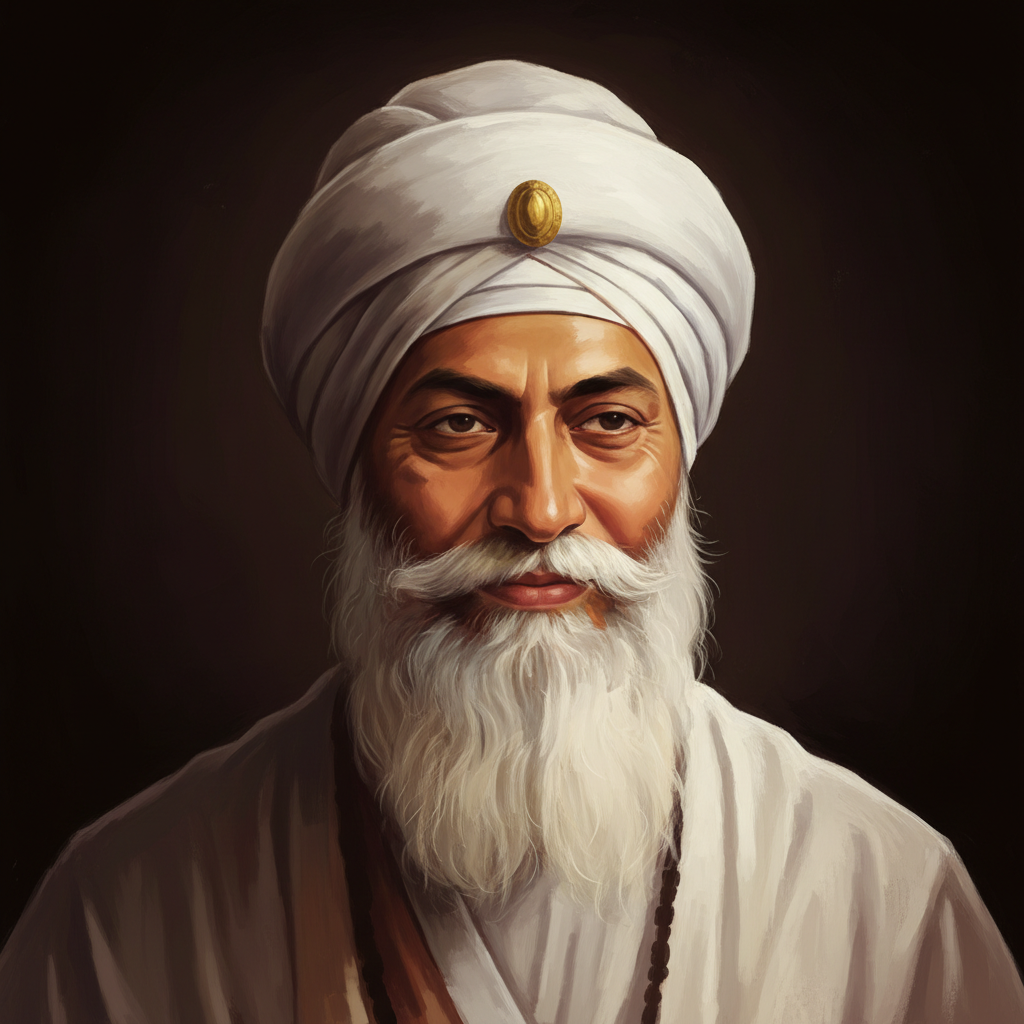
Guru Nanak — "The world is burning in the fire of desire, O Nanak, save it, save it, Lord!"
The world is burning in the fire of desire, O Nanak, save it, save it, Lord!
The world is burning in the fire of desire, O Nanak, save it, save it, Lord!
Click any product to generate a realistic preview. Up to 3 at a time.
* Initial load can take up to 90 seconds — revising the preview in another color is nearly instant.
"For each and every person, our Lord and Master provides sustenance. Why are you so afraid, O mind? The flamingos fly hundreds of miles, leaving their young ones behind. Who feeds them, and who teaches…"
"May your days be blessed and your phone battery never die mid-conversation."
"He alone is a Brahmin who knows God."
"Religion consists not in words; He who looks on all men as equal is religious."
"Like the juggler, deceiving by his tricks, one is deluded by egotism, falsehood and illusion."
Founder of Sikhism and the first of the Ten Sikh Gurus, whose teachings of one universal God and rejection of caste shaped Punjab. Closely associated with Kabir (mystical poet whose verses appear in the Sikh Guru Granth Sahib). For an intellectual contrast, see Brahmanical orthodoxy, the Hindu caste-and-ritual establishment of his era — Sikhism was founded as a deliberate alternative to both Hindu ritual hierarchy and Islamic exclusivism — Nanak's universalism was a structural rejection of caste and priestly mediation.
Found in 1 providers: grok
1 source checked
Humanity is consumed by endless wants—greed, lust, power, and ego—that scorch like flames and leave people restless and suffering. The speaker cries out for divine rescue, asking God to cool this burning and free beings from the grip of craving. It is both a diagnosis of the human condition and an urgent prayer: desire is destructive, and liberation comes not from satisfying it but from being lifted beyond it.
Guru Nanak (1469–1539) taught that attachment to maya—wealth, lust, anger, pride—traps the soul in suffering, and that only remembrance of the One Divine (Naam Simran) could free it. As Sikhism's founder, he traveled across South Asia and the Middle East preaching compassion, equality, and surrender to God. This verse mirrors his Japji Sahib and shabads, where he repeatedly pleads on humanity's behalf, positioning himself as servant rather than savior.
In early-modern 15th–16th century Punjab, Nanak lived amid Mughal conquest, Hindu-Muslim tension, rigid caste hierarchy, and ritualism he saw as spiritually hollow. Ordinary people endured war, Lodi-then-Babur invasions, forced conversions, and economic exploitation—literal and metaphorical fires. Against this, Nanak preached a direct, casteless devotion accessible to farmers and outcasts. Framing the world as 'burning' resonated with audiences watching villages razed and social orders collapse, offering spiritual refuge amid material chaos.
AI-generated insights based on extensive research and information for context. Factual errors? Email [email protected].
Your cart is empty