What it means
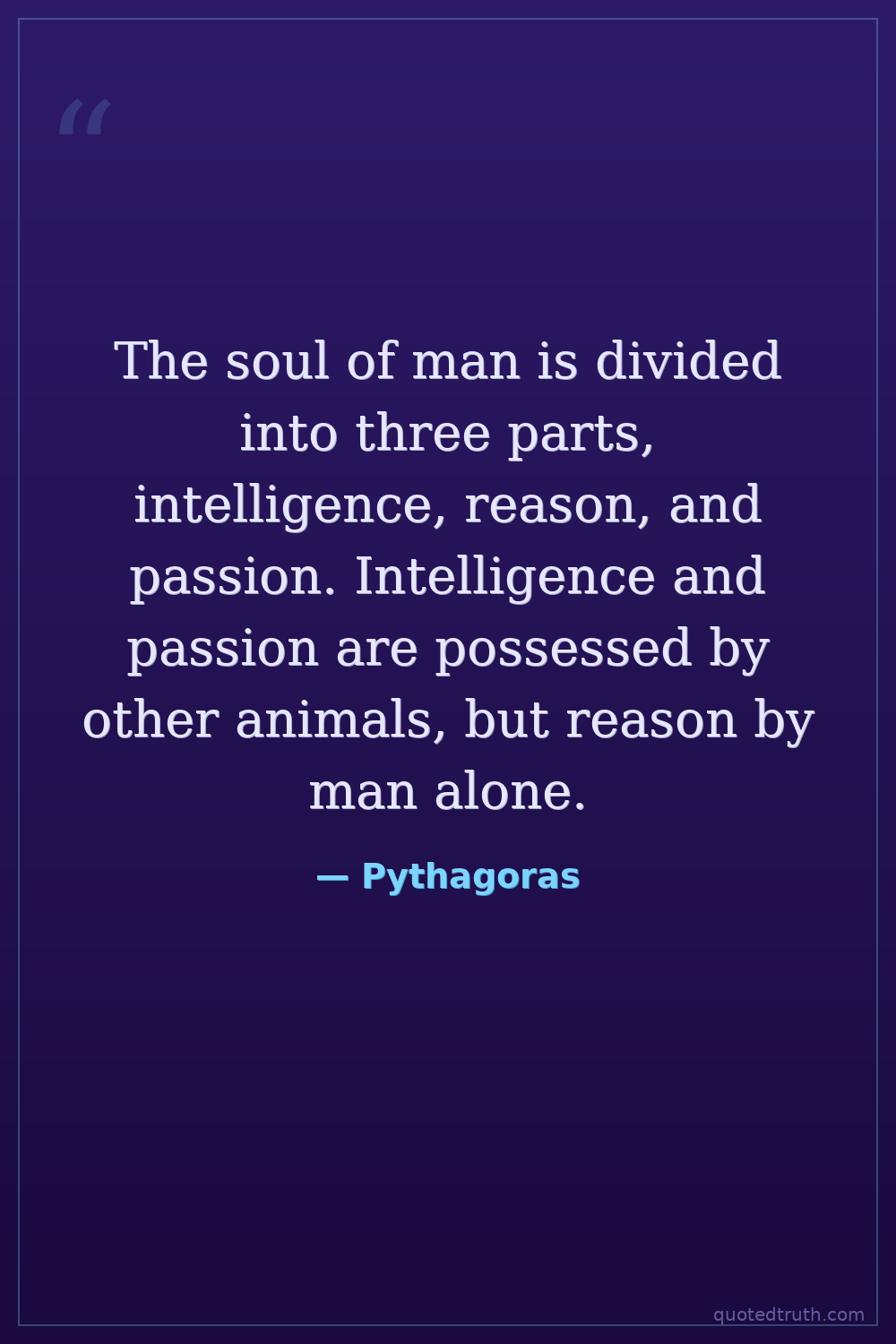
Humans share basic intelligence and emotional drives with animals, but rational thought—the ability to deliberate, reflect, and reason systematically—belongs to humans alone. This tripartite model of the soul ranks reason above instinct and passion as the defining human quality. The message: what truly separates us from other creatures isn't cleverness or feeling, but our capacity for structured, logical thought.
Relevance to Pythagoras
Pythagoras founded a religious-philosophical brotherhood around the belief that mathematical reasoning unlocks cosmic truth. His theorem and number mysticism both depended on pure rational thought, not instinct or emotion. This quote directly echoes his core philosophy: reason is the soul's highest faculty, the sacred tool that distinguishes humans and connects them to the divine mathematical order he believed governed all reality.
The era
In 6th-century BCE Greece, thinkers were actively dismantling mythological accounts of human nature. Pre-Socratic philosophers debated what separates humans from animals—a question centered on logos, rational speech and thought. Mystery religions competed with philosophy for spiritual authority. By declaring reason uniquely human, Pythagoras positioned mathematical and philosophical inquiry as humanity's highest pursuit at the very moment Greek intellectual culture was defining itself.
AI-generated insights based on extensive research and information for context. Factual errors? Email [email protected].