What it means
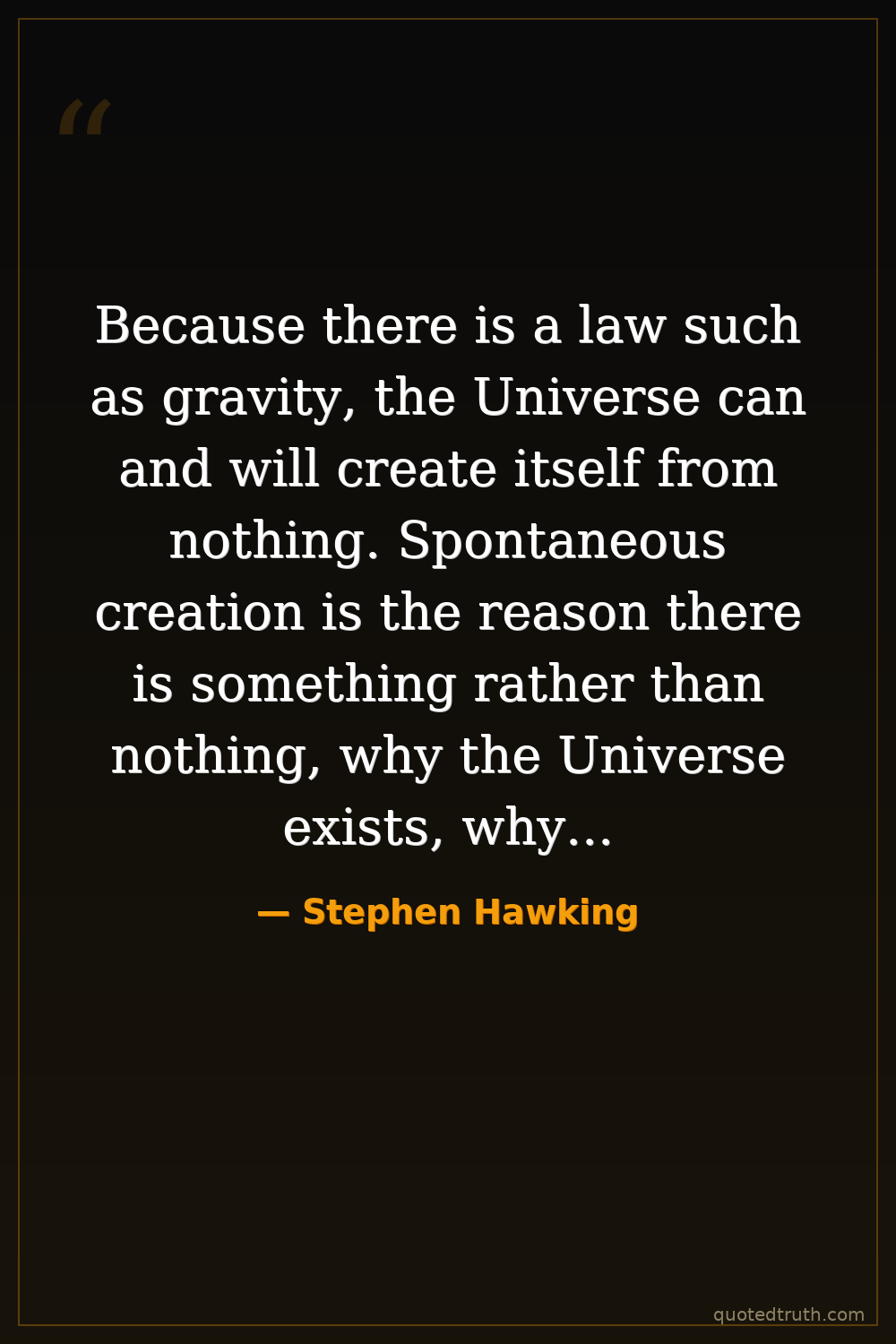
The laws of physics, particularly gravity, are sufficient to explain the universe's origin without invoking a creator. The universe didn't need a divine spark to begin — mathematical rules governing matter and energy alone can produce spontaneous creation from nothing. This is a direct claim that science provides a complete account of existence, rendering supernatural explanations unnecessary for understanding why anything exists at all.
Relevance to Stephen Hawking
Hawking spent decades on quantum cosmology, co-developing the no-boundary proposal with James Hartle, which argues the universe requires no external first cause. His research into Big Bang origins, black hole thermodynamics, and M-theory led to this conclusion. Openly atheist and contemptuous of supernatural shortcuts, he published this argument in The Grand Design (2010), framing it as physics' culmination in answering the deepest existential questions.
The era
Published in 2010 during peak New Atheism — Dawkins, Hitchens, and Dennett had made science-versus-religion a mainstream cultural battle, and intelligent design court cases were recent memory. Simultaneously, cosmological data from satellites like WMAP and advances in M-theory gave physicists precise tools to model the early universe, making equation-based explanations of cosmic origins scientifically credible and culturally urgent in ways previous generations couldn't have imagined.
AI-generated insights based on extensive research and information for context. Factual errors? Email [email protected].