Erwin Schrodinger — "By the way, I never realized that to be nonbelieving, to be an atheist, was a th…"
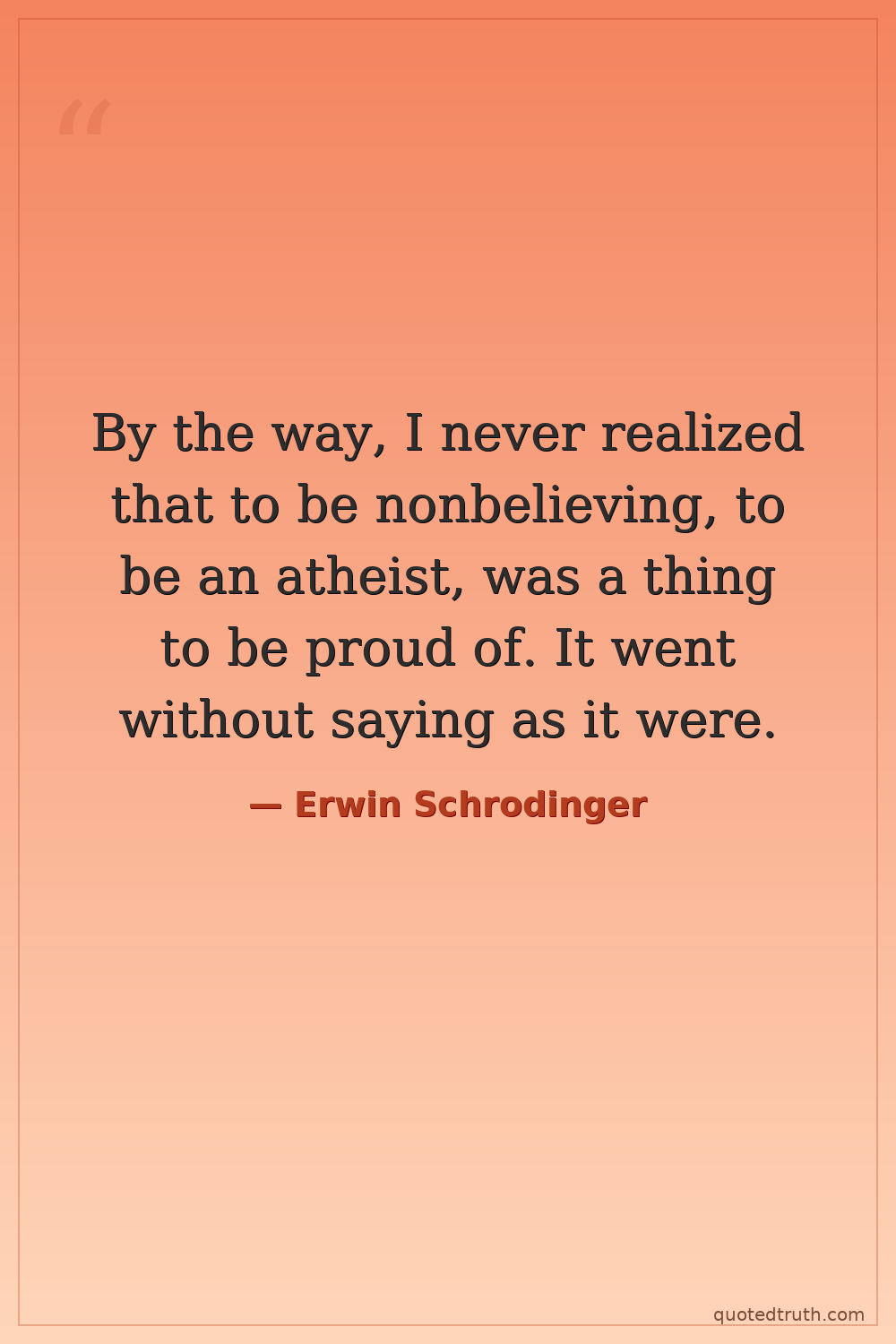
By the way, I never realized that to be nonbelieving, to be an atheist, was a thing to be proud of. It went without saying as it were.
By the way, I never realized that to be nonbelieving, to be an atheist, was a thing to be proud of. It went without saying as it were.
Click any product to generate a realistic preview. Up to 3 at a time.
* Initial load can take up to 90 seconds — revising the preview in another color is nearly instant.
"Consciousness cannot be accounted for in physical terms. For consciousness is absolutely fundamental. It cannot be accounted for in terms of anything else."
"The world is a dream, but it is a dream that we can shape."
"I am no friend of probability theory, I have hated it from the first moment when our dear friend Max Born gave it birth. For it could be seen how easy and simple it made everything, in principle, ever…"
"The world is not a collection of independent objects, but a single, indivisible whole."
"The reason why our sentient, percipient and thinking ego is met nowhere within our scientific world picture can easily be indicated in seven words: because it is itself that world picture."
Austrian physicist who shared the 1933 Nobel for the wave equation that bears his name and the famous cat thought-experiment. Closely associated with Werner Heisenberg (matrix-mechanics rival who reached the same physics by different math) and Albert Einstein (his pen-pal on quantum interpretation). For an intellectual contrast, see Niels Bohr, Danish physicist and architect of the Copenhagen interpretation — Schrödinger's cat thought-experiment was specifically designed to ridicule Bohr's 'observer-dependent reality' reading of quantum mechanics — Schrödinger thought the Copenhagen interpretation was absurd; the cat was meant as reductio ad absurdum.
Found in 1 providers: gemini
1 source checked
The speaker expresses that atheism wasn't a bold stance or identity for them — it was simply the default, unremarkable conclusion of rational thinking. No pride was attached because no struggle was involved. Disbelief in god required no announcement or courage; it was as natural and obvious as any other self-evident fact, needing no special acknowledgment or celebration.
Schrödinger was a physicist who spent his career reducing reality to mathematical structure and wave equations. His intellectual framework was empirical and rigorously logical. Having formulated quantum wave mechanics and grappled with fundamental questions about observation and reality, religious supernaturalism simply had no explanatory foothold. His atheism was a byproduct of his scientific worldview, not a rebellious position.
Schrödinger worked through the early-to-mid 20th century, a period when Europe's educated scientific class was broadly secular, particularly in Vienna and later Berlin. Post-WWI intellectual culture had deeply questioned religious institutions. Among academic physicists — Bohr, Heisenberg, Einstein's circle — naturalistic worldviews were common currency, making overt atheism less a declaration than an unstated professional baseline.
AI-generated insights based on extensive research and information for context. Factual errors? Email [email protected].
Your cart is empty