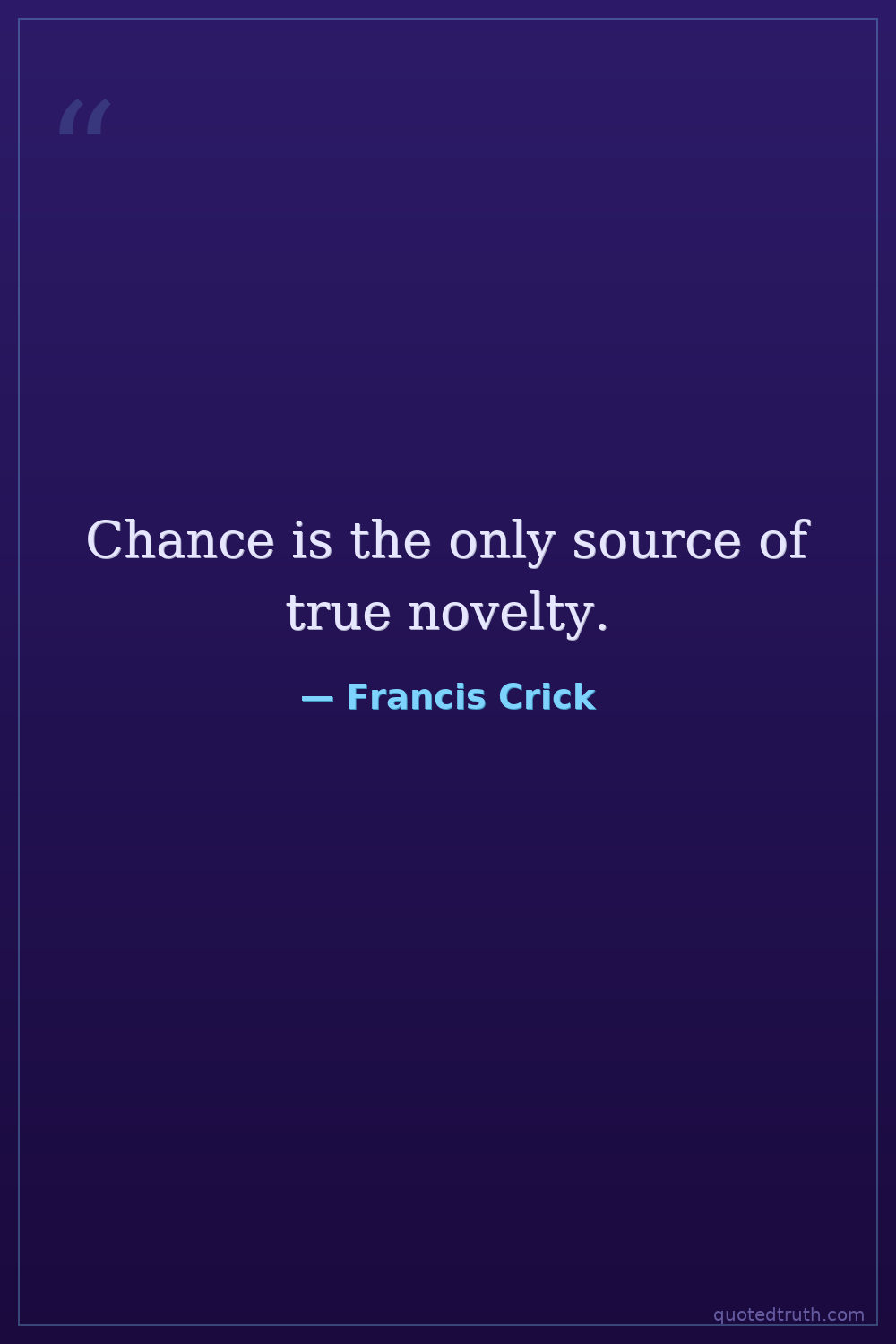
Francis Crick — "Chance is the only source of true novelty."
Chance is the only source of true novelty.
Chance is the only source of true novelty.
Click any product to generate a realistic preview. Up to 3 at a time.
* Initial load can take up to 90 seconds — revising the preview in another color is nearly instant.
"We have discovered the secret of life."
"I do not believe that God exists."
"The ultimate aim of the modern movement in biology is in fact to explain all biology in terms of physics and chemistry."
"You, your joys and your sorrows, your memories and your ambitions, your sense of personal identity and free will, are in fact no more than the behavior of a vast assembly of nerve cells and their asso…"
"Our minds are just a lot of neurons firing."
Found in 1 providers: grok
1 source checked
True novelty means something genuinely unprecedented, not just a new arrangement of existing elements. Crick argues that deterministic processes can only produce outcomes predictable from prior states—elaborate, but not truly new. Only chance—random mutation, random quantum events, unpredictable accidents—introduces something the universe hasn't seen before. Without randomness, reality would just replay itself indefinitely. Chance is the wild card that breaks causal chains and makes genuine innovation possible.
Crick co-discovered DNA's double helix—the molecule encoding life's instructions. His work showed random mutations in DNA sequence, not design, drive evolution's creative power. He arrived at biology by chance himself: WWII destroyed his physics research, redirecting his career. A committed atheist and materialist, Crick believed life and consciousness emerge from chemistry alone, with no guiding hand—making chance the only available architect of genuine novelty.
Crick worked amid two revolutions: quantum mechanics had proven subatomic events are irreducibly random, and molecular biology was rewriting life as chemistry. Jacques Monod's 1970 book Chance and Necessity echoed this view—life arose from random mutation, not cosmic purpose. The Cold War era's secular scientism pushed back against religious determinism. DNA's discovery made the mechanism of random mutation concrete and measurable, grounding philosophical claims about chance in hard molecular evidence.
AI-generated insights based on extensive research and information for context. Factual errors? Email [email protected].
Your cart is empty