What it means
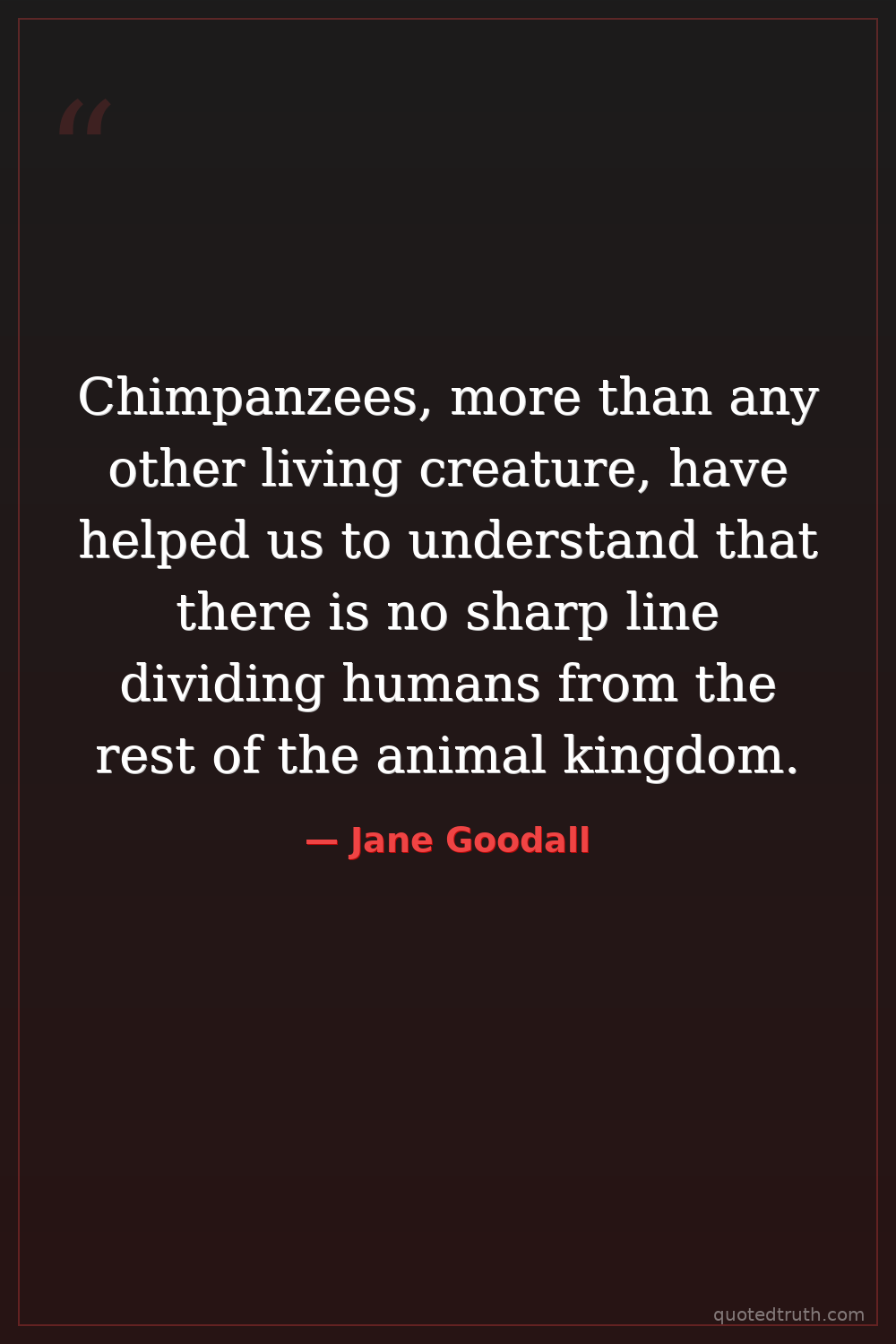
No clear biological boundary separates humans from other animals. The traits we once considered exclusively human—tool use, complex emotion, social bonds, problem-solving—exist on a continuum across species. Chimpanzees demonstrate this most vividly, forcing us to reconsider human uniqueness and our relationship to the broader animal world with humility rather than assumed superiority.
Relevance to Jane Goodall
Goodall spent decades at Gombe Stream observing chimpanzees using tools, expressing grief, forming friendships, and waging war—behaviors once deemed purely human. Her 1960 discovery of tool use shattered the accepted human-animal divide and prompted Louis Leakey to redefine either 'tool,' 'man,' or both. Her life's work rests on dissolving that false boundary.
The era
Goodall began her research in 1960, when the post-war scientific consensus still placed humans categorically apart from animals. The Modern Synthesis had just unified evolutionary biology, yet social resistance to human-animal continuity remained strong. Her findings arrived alongside rising environmentalism and eventually reshaped conservation ethics, animal cognition research, and how humanity legally and morally treats other species.
AI-generated insights based on extensive research and information for context. Factual errors? Email [email protected].