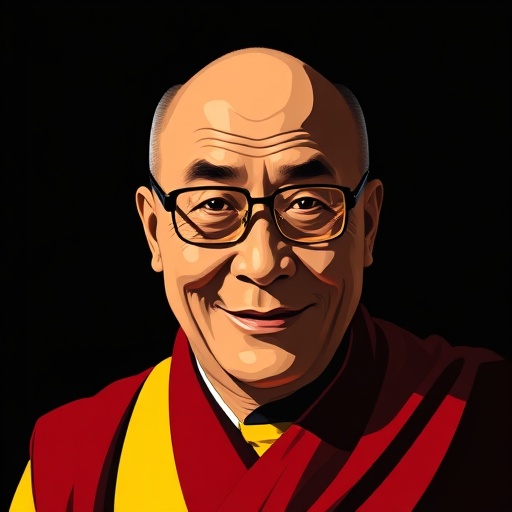
Dalai Lama (14th) — "China has turned Tibet into a hell on earth."
China has turned Tibet into a hell on earth.
China has turned Tibet into a hell on earth.
Click any product to generate a realistic preview. Up to 3 at a time.
* Initial load can take up to 90 seconds — revising the preview in another color is nearly instant.
"I am a simple person. I don't have many possessions. I just have my robes and my beads."
"When we meet real tragedy in life, we can react in two ways — either by losing hope and falling into self-destructive habits, or by using the challenge to find our inner strength."
"My hair is getting thin, and my teeth are falling out. But my mind is still very sharp."
"In the practice of tolerance, one’s enemy is the best teacher."
"Old friends pass away, new friends appear. It is just like the days. An old day passes, a new day arrives. The important thing is to make it meaningful: a meaningful friend — or a meaningful day."
Found in 1 providers: deepseek
1 source checked
Tibet, once a sovereign Buddhist nation, was occupied by China beginning in 1950. This quote declares that Chinese governance transformed Tibet from a spiritually centered society into a place of extreme suffering—through suppression of religious practice, imprisonment of monks, destruction of cultural institutions, forced political indoctrination, and displacement of the Tibetan people. "Hell on earth" conveys conditions so brutal they amount to systematic cultural and spiritual annihilation.
Tenzin Gyatso fled Tibet in 1959 after China crushed an independence uprising, establishing a government-in-exile in Dharamsala, India. This condemnation comes from someone who lost not just a homeland but custodianship of an entire civilization. His lifelong commitment to nonviolence—earning the 1989 Nobel Peace Prize—makes this stark language significant. When even the pacifist leader reaches for "hell," it underscores the severity of what Tibetans have endured under Chinese administration.
China's occupation of Tibet began in 1950 and intensified through the Cultural Revolution (1966–1976), which destroyed over 6,000 Tibetan monasteries. Subsequent decades brought continued repression—mass imprisonments, torture of dissidents, restrictions on Buddhist practice, and Han Chinese migration that altered Tibet's demographics. Over 100 Tibetan monks self-immolated in protest after 2009. International human rights organizations documented systematic abuses, yet geopolitical realities have largely shielded China from meaningful international accountability.
AI-generated insights based on extensive research and information for context. Factual errors? Email [email protected].
Your cart is empty