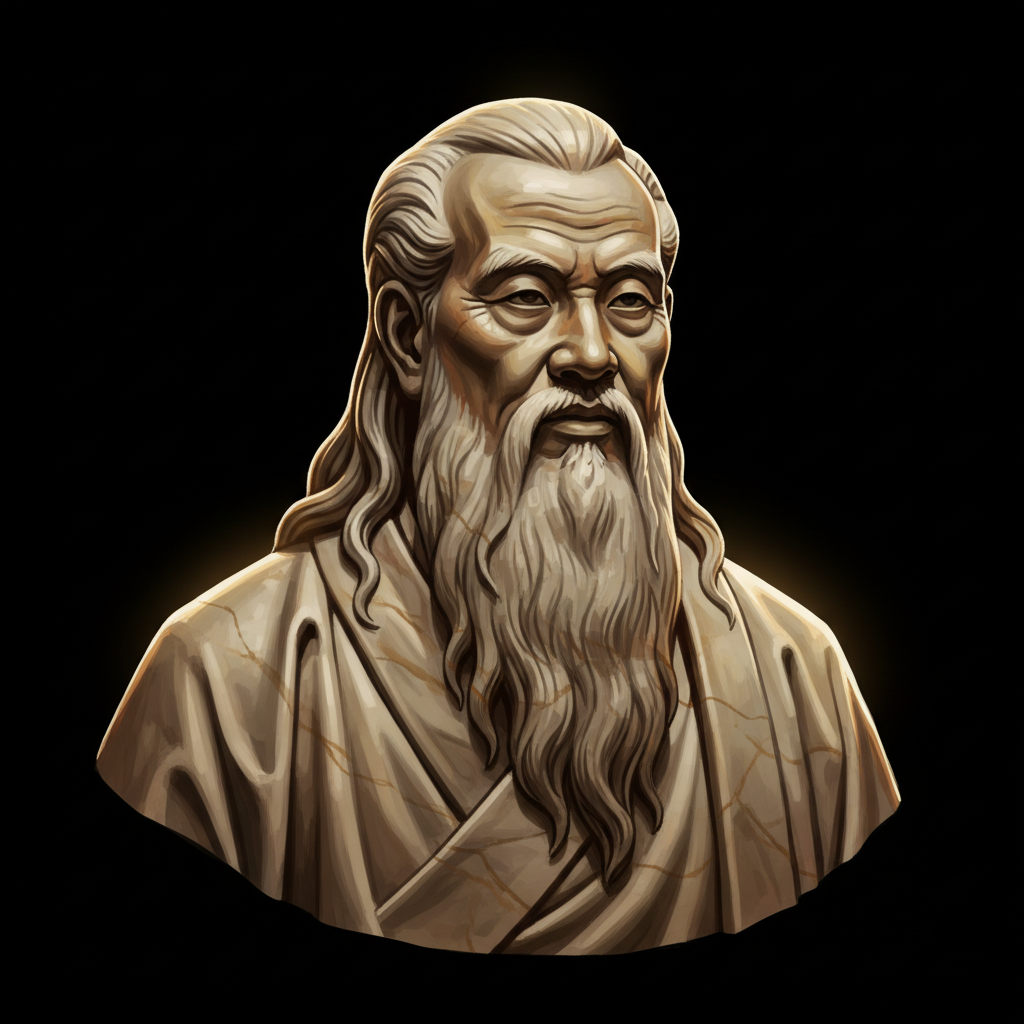
Laozi — "Deal with the small as with the large."
Deal with the small as with the large.
Deal with the small as with the large.
Click any product to generate a realistic preview. Up to 3 at a time.
* Initial load can take up to 90 seconds — revising the preview in another color is nearly instant.
"The more prohibitions there are, the poorer the people will be."
"The universe is a sacred vase. It should not be tampered with."
"If a nation is to be great, it must be like a great river, it must flow freely in every direction."
"The sage, because he does not contend, is therefore without reproach."
"One who is too insistent on his own views finds few who agree with him."
Reputed founder of Taoism and author of the Tao Te Ching, whose wu wei (effortless action) shaped East Asian philosophy. Closely associated with Zhuangzi (later Taoist who extended Laozi's framework). For an intellectual contrast, see Confucius, near-contemporary Chinese sage of social ritual and duty — Confucius systematized social order through ritual and hierarchy; Laozi argued that all such systems were the disease, not the cure — the two founding poles of Chinese moral philosophy.
Found in 1 providers: gemini
1 source checked
Give the same care and attention to minor matters that you would to major ones. Small problems, decisions, or tasks deserve genuine focus because they often grow into larger ones if neglected, or they quietly shape the outcome of bigger efforts. Treating trivial things carelessly while saving effort only for what seems important leads to sloppy results and missed warnings. Consistency of attention, regardless of scale, produces better work and prevents avoidable failures.
Laozi taught that the sage handles difficulties while they are still easy and tackles great things while they are still small, a principle woven through the Tao Te Ching. As a reputed archivist in the Zhou court, he observed how dynasties unraveled from neglected details. His philosophy of wu wei, effortless action, depends on early, attentive engagement so problems never swell beyond control, making this saying a direct expression of his core method.
Laozi lived during the late Zhou period, around the 6th century BCE, as centralized authority decayed into the Spring and Autumn era's constant warfare among rival states. Rulers chased grand conquests while ignoring administrative rot, peasant suffering, and small breaches of ritual that signaled collapse. Against this backdrop of ambition outrunning prudence, Laozi's counsel to treat the small with the same seriousness as the large was a quiet rebuke to leaders who mistook scale for importance and overlooked the roots of ruin.
AI-generated insights based on extensive research and information for context. Factual errors? Email [email protected].
Your cart is empty