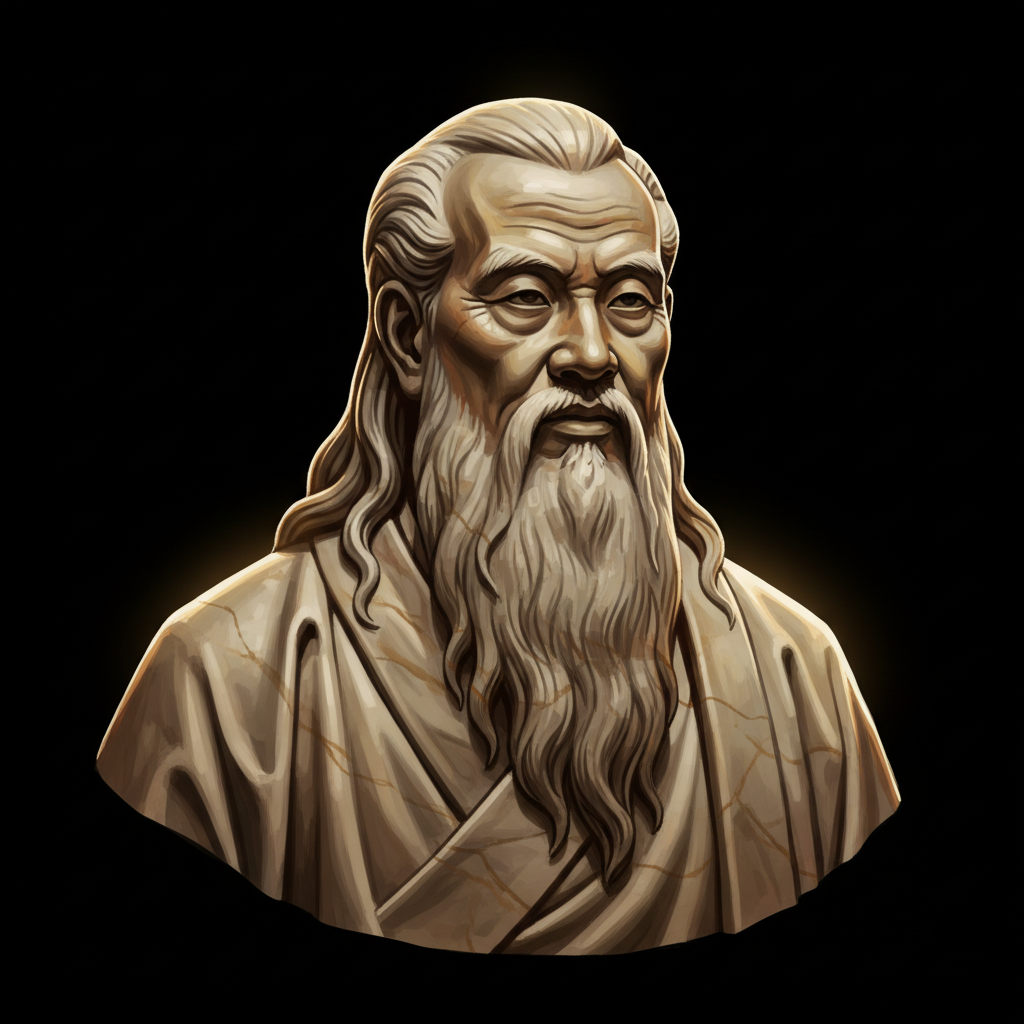
Laozi — "One who is too insistent on his own views finds few who agree with him."
One who is too insistent on his own views finds few who agree with him.
One who is too insistent on his own views finds few who agree with him.
Click any product to generate a realistic preview. Up to 3 at a time.
* Initial load can take up to 90 seconds — revising the preview in another color is nearly instant.
"The journey of a thousand miles begins with a single step."
"The sage attends to the inner and not to the outer."
"The great square has no corners. The great vessel takes a long time to complete. The great sound is faint. The great image has no form."
"Use justice to rule a country. Use surprise to wage war. Use non-action to govern the world."
"When people see some things as beautiful, other things become ugly. When people see some things as good, other things become bad."
Reputed founder of Taoism and author of the Tao Te Ching, whose wu wei (effortless action) shaped East Asian philosophy. Closely associated with Zhuangzi (later Taoist who extended Laozi's framework). For an intellectual contrast, see Confucius, near-contemporary Chinese sage of social ritual and duty — Confucius systematized social order through ritual and hierarchy; Laozi argued that all such systems were the disease, not the cure — the two founding poles of Chinese moral philosophy.
Found in 1 providers: grok
1 source checked
Pushing your opinions too hard drives people away instead of winning them over. When someone argues aggressively, corrects constantly, or refuses to consider alternatives, others stop engaging and stop agreeing, even on points where they might have nodded along. Flexibility and listening build alignment; rigidity breeds isolation. The harder you grip a position, the fewer allies you keep. Persuasion works through openness, not force, and stubborn certainty tends to empty the room.
Laozi taught wu wei, effortless action, and the power of yielding over forcing. He compared the sage to water, which wins by flowing around obstacles rather than crashing through them. A legendary archivist said to have left society quietly rather than argue with a rigid world, he consistently warned that hardness breaks while softness endures. This saying reflects his core conviction that the rigid mind, like the rigid tree, snaps first.
Laozi lived during the late Zhou dynasty, an era of collapsing royal authority, warring states, and rival philosophical schools competing for rulers' ears. Confucians pushed rigid ritual, Legalists pushed harsh law, and itinerant advisers shouted over each other at courts. In that climate of dogmatic insistence and ideological combat, Laozi's warning landed sharply: the loudest, most certain voices often persuaded no one and accelerated the chaos their certainty claimed to cure.
AI-generated insights based on extensive research and information for context. Factual errors? Email [email protected].
Your cart is empty