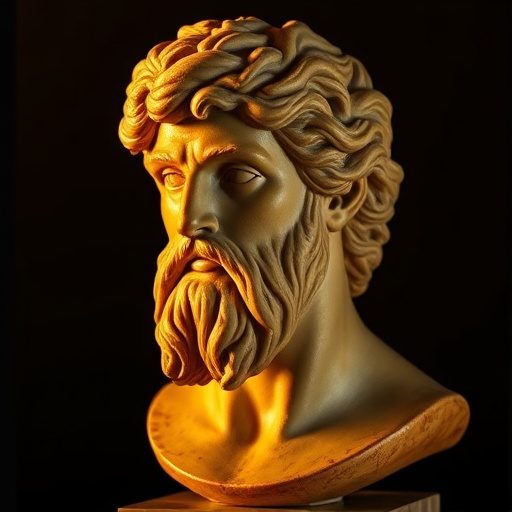
Pythagoras — "If you're asked: What is the silence? Respond: It is the first stone of the Wisd…"
If you're asked: What is the silence? Respond: It is the first stone of the Wisdom's temple.
If you're asked: What is the silence? Respond: It is the first stone of the Wisdom's temple.
Click any product to generate a realistic preview. Up to 3 at a time.
* Initial load can take up to 90 seconds — revising the preview in another color is nearly instant.
"If you have a wounded heart, touch it as little as you would an injured eye. There are only two remedies for the suffering of the soul: hope and patience."
"Reason is immortal, all else mortal."
"A thought is an idea in transit."
"A man is never free unless he is master of himself."
"Neither be covetous nor stingy; a due measure is excellent in these things."
Greek philosopher and mathematician whose school in Croton combined geometry (the Pythagorean theorem), number-mysticism, and a religious-vegetarian way of life. Closely associated with Thales of Miletus (earlier pre-Socratic and the first philosopher). For an intellectual contrast, see Heraclitus, pre-Socratic Greek philosopher of flux — Heraclitus called Pythagoras 'the chief of swindlers' — among the founding insults of the philosophical-rivalry tradition. Their 'all is flux' vs 'all is number' poles still organize the philosophy of mathematics today (Platonist vs anti-realist).
A philosophical riddle and answer, emphasizing the importance of silence.
Date: c. 570-495 BCE (attributed later)
BiblicalFound in 1 providers: gemini
1 source checked
Silence is the foundation of wisdom — not emptiness, but the prerequisite discipline of listening, observing, and restraining impulsive speech before understanding is achieved. True knowledge begins when you stop filling space with noise and create the mental conditions for deep thought. The quote frames silence not as passive absence but as an active, constructive first step — the cornerstone upon which genuine understanding is built.
Pythagoras famously required initiates into his Brotherhood to observe a five-year vow of silence before being permitted to speak in his presence or engage in philosophical discourse. He believed disciplined silence cultivated the receptive mind needed for mathematics and metaphysics. For him, self-mastery preceded intellectual mastery — silence was not punishment but training, conditioning the student to receive truth rather than project noise.
In ancient Greece of the 6th century BCE, oral culture dominated — rhetoric, debate, and persuasion were prized civic virtues. Sophists sold the art of compelling speech regardless of truth. Against this backdrop, Pythagoras's elevation of silence was radical: it prioritized inner contemplation over public performance. His Brotherhood operated as a mystery school where esoteric knowledge was sacred, not broadcast — silence protected both the teachings and the student's developing mind.
AI-generated insights based on extensive research and information for context. Factual errors? Email [email protected].
Your cart is empty