What it means
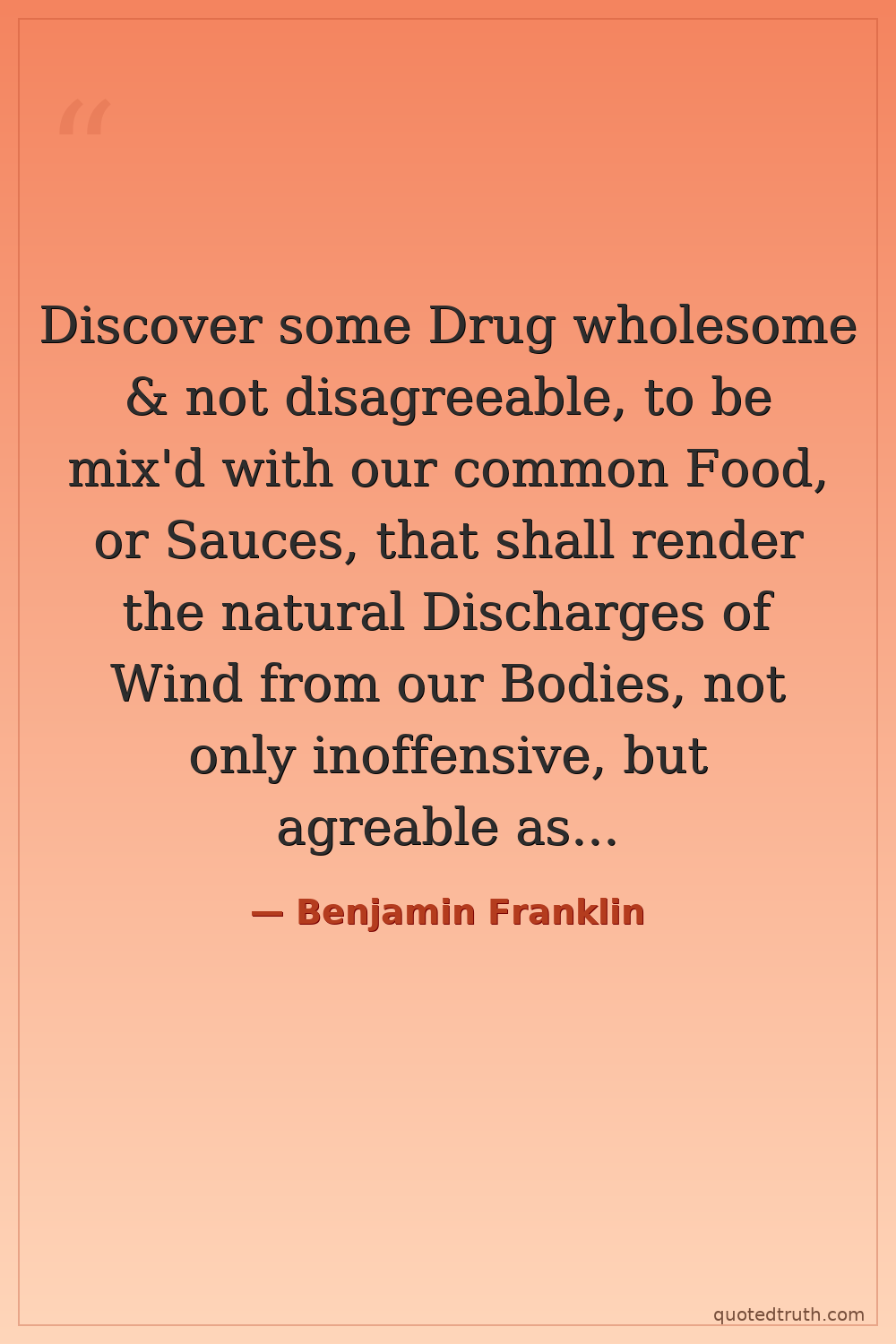
The speaker proposes developing a food additive or drug that would neutralize the odor of intestinal gas — going further, making it smell pleasant, even perfume-like. Framed in mock-scientific language, the idea is that human flatulence is universal, unavoidable, and socially awkward, so why hasn't science solved it? It's a deadpan argument that practical, everyday human problems deserve serious scientific attention just as much as abstract theories.
Relevance to Benjamin Franklin
Franklin wrote this circa 1781 as his satirical essay 'To the Royal Academy of Farting,' penned while serving as American minister to France. It reflects his lifelong belief that science should serve practical human needs — the same conviction that drove his lightning rod and bifocals. He was also a notorious wit and prankster who used humor as intellectual critique, and his Poor Richard's Almanack shows the same earthy, irreverent sensibility toward bodily realities.
The era
In the 1780s, European learned academies were multiplying rapidly, often debating esoteric or trivial questions with pompous formality. The Enlightenment elevated reason and systematic inquiry, but critics saw much academic output as uselessly abstract. Franklin, embedded in Paris's intellectual salons, targeted this disconnect between scholarly prestige and practical benefit. Chemistry was also emerging as a serious science, making a mock-proposal about digestive chemistry pointedly timely and recognizable to his audience.
AI-generated insights based on extensive research and information for context. Factual errors? Email [email protected].