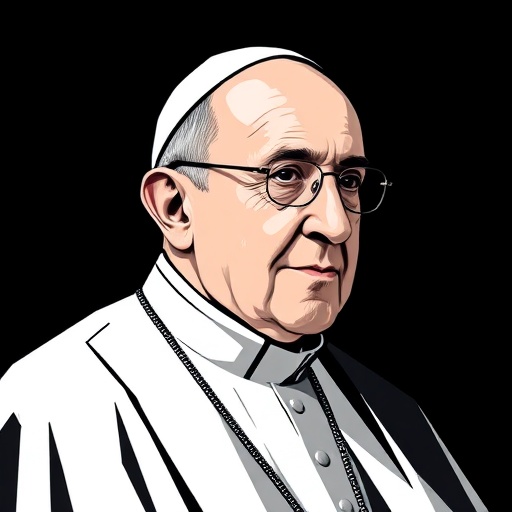
Pope Francis — "Do not be afraid of joy."
Do not be afraid of joy.
Do not be afraid of joy.
Click any product to generate a realistic preview. Up to 3 at a time.
* Initial load can take up to 90 seconds — revising the preview in another color is nearly instant.
"The greatest scandal is poverty."
"I’ll tell you something. I don’t watch television. It’s been 25 years since I’ve watched television. It's not a vow, but I decided it on a certain moment when I felt that it didn't do me any good."
"I would like to go to Moscow. And not only Moscow. To all of Russia. But you need two to tango."
"The world tells us to seek success, power, and money; God tells us to seek humility, service, and love."
"The Holy Spirit is a troublemaker."
First Latin American and Jesuit pope (2013-), who has steered the Catholic Church toward pastoral inclusion on LGBTQ pastoral care, divorced Catholics, and climate. Closely associated with Pope John XXIII (the Vatican II reformer pope) and Cardinal Walter Kasper (his theological ally on pastoral reform). For an intellectual contrast, see Cardinal Raymond Burke, American traditionalist cardinal, former head of the Vatican Apostolic Signatura — Burke is the public face of Catholic traditionalism that views Francis's pastoral approach as doctrinally dangerous — he has formally challenged Amoris Laetitia and other Francis reforms.
Found in 1 providers: grok
1 source checked
Do not be afraid of joy urges people to stop holding back happiness — whether from guilt, fear of vulnerability, or the sense that suffering is more worthy than delight. It insists that joy is not frivolous or fleeting but something to be claimed fully. In a world that often rewards stoicism or treats contentment with suspicion, it is a direct challenge to embrace life's good moments without apology.
Pope Francis built his entire papacy around joy as a spiritual imperative. His 2013 apostolic exhortation Evangelii Gaudium (The Joy of the Gospel) opens by declaring joy the heart of Christian life. A Jesuit shaped by pastoral work among Buenos Aires's poor, he repeatedly warned that a "sad Christian" is a contradiction. His informal style — laughing easily, embracing crowds — embodies the belief that faith should radiate warmth rather than severity.
Pope Francis became pope in 2013 amid a Church reeling from clergy abuse scandals and declining attendance in Western nations. Broader society was navigating rising anxiety, social media's pressure to perform happiness while feeling hollow, and growing political despair. His call not to fear joy cut against both institutional grimness and cultural cynicism — positioning authentic delight as an act of resistance and a spiritual necessity rather than an indulgence.
AI-generated insights based on extensive research and information for context. Factual errors? Email [email protected].
Your cart is empty