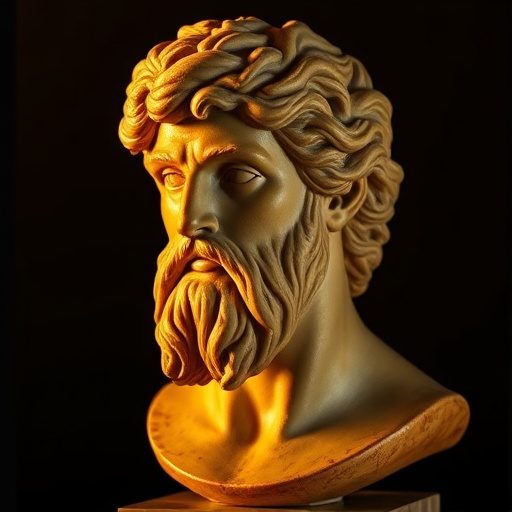
Pythagoras — "Do not eat beans."
Do not eat beans.
Do not eat beans.
Click any product to generate a realistic preview. Up to 3 at a time.
* Initial load can take up to 90 seconds — revising the preview in another color is nearly instant.
"If there be light, then there is darkness; if cold, heat; if height, depth; if solid, fluid; if hard, soft; if rough, smooth; if calm, tempest; if prosperity, adversity; if life, death."
"A man is never free unless he is master of himself."
"Learn to be silent. Let your quiet mind listen and absorb."
"The soul is immortal and undergoes transmigration."
"Do nothing evil, neither in the presence of others, nor privately; But above all things respect yourself."
Greek philosopher and mathematician whose school in Croton combined geometry (the Pythagorean theorem), number-mysticism, and a religious-vegetarian way of life. Closely associated with Thales of Miletus (earlier pre-Socratic and the first philosopher). For an intellectual contrast, see Heraclitus, pre-Socratic Greek philosopher of flux — Heraclitus called Pythagoras 'the chief of swindlers' — among the founding insults of the philosophical-rivalry tradition. Their 'all is flux' vs 'all is number' poles still organize the philosophy of mathematics today (Platonist vs anti-realist).
A well-known and often ridiculed prohibition among Pythagoreans, the reasons for which are debated (e.g., flatulence, resemblance to genitalia, connection to the underworld).
Date: c. 570 – c. 495 BC
ShockingFound in 1 providers: grok
1 source checked
Avoid beans entirely — this was a serious command, not a health tip. At its core, the instruction concerns spiritual discipline and purity: certain foods could corrupt the mind, disrupt focus, or even harm the soul. Whether read literally or symbolically, it reflects a belief that what you consume shapes who you are, and that a philosopher must impose strict self-control over bodily appetites to pursue higher truth.
Pythagoras founded a strict religious brotherhood in Croton governed by detailed rules called akousmata. He believed in metempsychosis — the transmigration of souls through humans, animals, and perhaps plants. Beans were thought to house human souls, and eating one could mean destroying a person's reincarnated spirit. For someone who devoted his life to cosmic order and numerical harmony, this prohibition was inseparable from his deepest religious and philosophical convictions.
In 6th-century BCE Greece, beans carried political and ritual weight — used in Athenian democracy for casting votes and offered at funerary rites connecting the living to the dead. Orphic mystery traditions, deeply influential in Pythagoras's world, taught that souls migrated between bodies across lifetimes. His community in Croton operated within a culture where religion, diet, and philosophy were inseparable, and dietary purity was considered essential for achieving the contemplative clarity needed to grasp divine mathematical order.
AI-generated insights based on extensive research and information for context. Factual errors? Email [email protected].
Your cart is empty