What it means
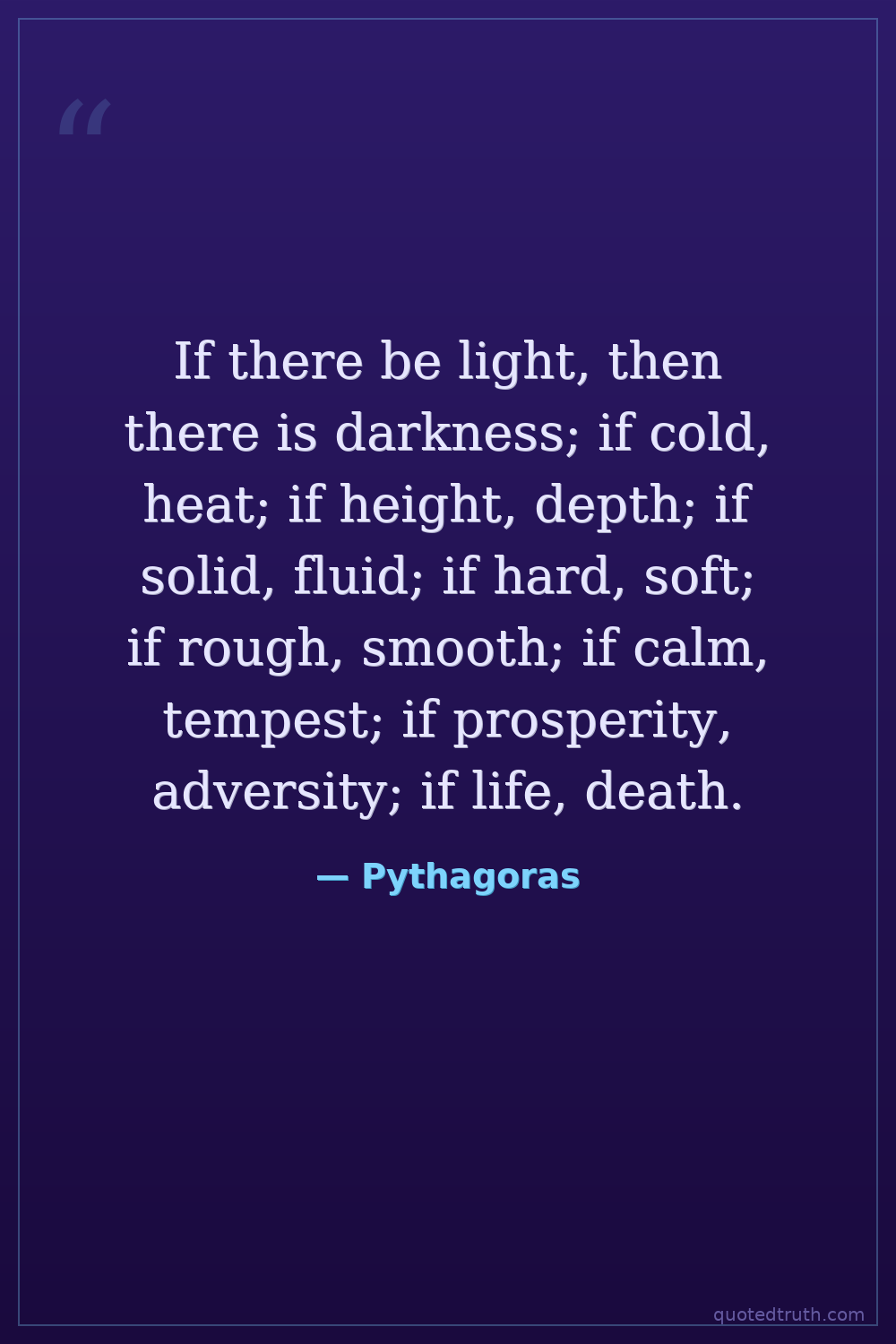
Reality is built from opposing pairs — you cannot have one without the other. Light only exists because darkness exists; life only has meaning because death exists. Every quality, condition, or experience requires its opposite to be real. Without contrast, nothing could be perceived or understood. The universe is structured as complementary dualities, and recognizing this balance is essential to understanding existence itself.
Relevance to Pythagoras
Pythagoras founded a philosophical brotherhood at Croton that treated mathematics and cosmology as spiritual disciplines. His famous theorem revealed that abstract relationships govern physical reality. His school taught that the cosmos operates through harmonia — balanced ratios and opposites in tension. This dualistic worldview extended his mathematical insight that structure emerges from paired relationships directly into metaphysics and moral philosophy.
The era
In 6th-century BCE Greece, pre-Socratic thinkers were dismantling mythological explanations of nature and replacing them with rational principles. Heraclitus simultaneously proposed that opposites unify into a single logos. Eastern traditions — Persian Zoroastrianism, early Taoist thought — were developing similar dualistic frameworks. Pythagoras traveled to Egypt and Babylon, absorbing cosmological ideas. Framing reality as balanced opposites was a radical intellectual move against Homer's personal, divine-will-driven universe.
AI-generated insights based on extensive research and information for context. Factual errors? Email [email protected].