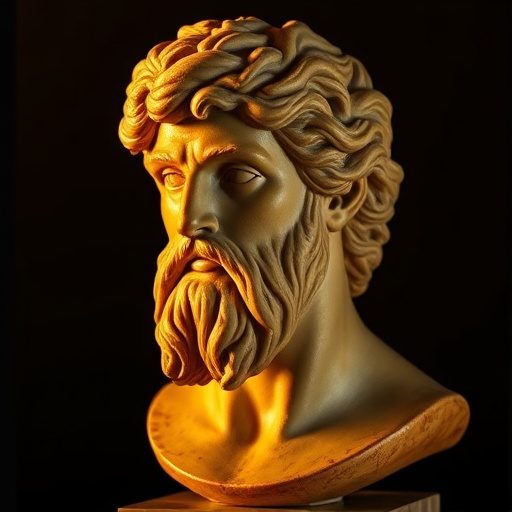
Pythagoras — "Do nothing evil, neither in the presence of others, nor privately; But above all…"
Do nothing evil, neither in the presence of others, nor privately; But above all things respect yourself.
Do nothing evil, neither in the presence of others, nor privately; But above all things respect yourself.
Click any product to generate a realistic preview. Up to 3 at a time.
* Initial load can take up to 90 seconds — revising the preview in another color is nearly instant.
"Let no one persuade you by word or deed to do or say whatever is not best for you."
"Don't walk on the highway."
"When abroad, don't turn back at the border."
"The souls of animals called unreasoning are reasonable, not however with active reasoning powers, because of an imperfect mixture of the bodies and because they do not have the power of speech, as in …"
"Friendship is one soul in two bodies."
Greek philosopher and mathematician whose school in Croton combined geometry (the Pythagorean theorem), number-mysticism, and a religious-vegetarian way of life. Closely associated with Thales of Miletus (earlier pre-Socratic and the first philosopher). For an intellectual contrast, see Heraclitus, pre-Socratic Greek philosopher of flux — Heraclitus called Pythagoras 'the chief of swindlers' — among the founding insults of the philosophical-rivalry tradition. Their 'all is flux' vs 'all is number' poles still organize the philosophy of mathematics today (Platonist vs anti-realist).
Found in 1 providers: gemini
1 source checked
Integrity means behaving the same whether or not anyone is watching. This quote urges you to refuse wrongdoing in public and in private — because the real test of character happens alone. Above that, it places self-respect as the highest authority: your own conscience and judgment matter more than external approval or social pressure. Living ethically isn't about avoiding punishment; it's about maintaining an honest relationship with yourself.
Pythagoras founded a strict philosophical brotherhood in Croton, southern Italy, where members followed rigorous moral codes — vegetarianism, communal property, silence disciplines, and personal purification. He taught that the soul undergoes transmigration and must be kept morally clean across lifetimes. For Pythagoras, mathematics and ethics were unified: both demanded precision and internal discipline. Self-respect, not fear of social judgment, was the engine of virtuous living in his community.
Ancient Greece around 500 BCE was an honor-shame culture — reputation among peers determined social standing, not private conscience. Pythagoras lived as Greek city-states competed fiercely and public image dominated ethics. His insistence on private moral conduct was radical: most Greeks feared social disgrace more than personal wrongdoing. Mystery religions and Orphic cults were reshaping ideas about the soul and afterlife, making personal moral purity a new philosophical concern.
AI-generated insights based on extensive research and information for context. Factual errors? Email [email protected].
Your cart is empty