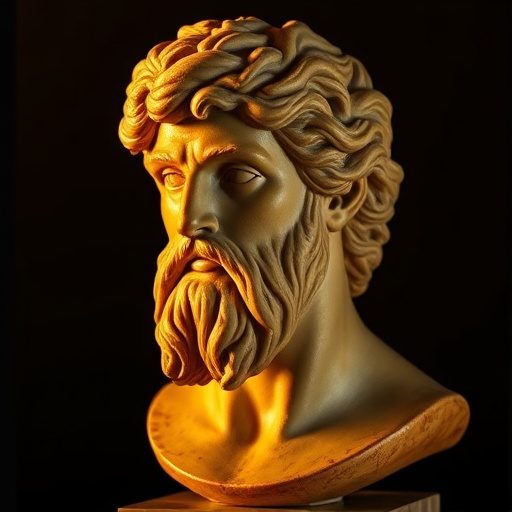
Pythagoras — "Do not look in a mirror by lamplight."
Do not look in a mirror by lamplight.
Do not look in a mirror by lamplight.
Click any product to generate a realistic preview. Up to 3 at a time.
* Initial load can take up to 90 seconds — revising the preview in another color is nearly instant.
"We come from God, and we return to God."
"Don't mix a fire with a knife."
"He who sows virtue reaps honor."
"Spit upon the parings of your nails, and the clippings of your hair."
"Do not go to bed until you have gone over the day three times in your mind. What did I do wrong? What did I do right? What did I leave undone?"
Greek philosopher and mathematician whose school in Croton combined geometry (the Pythagorean theorem), number-mysticism, and a religious-vegetarian way of life. Closely associated with Thales of Miletus (earlier pre-Socratic and the first philosopher). For an intellectual contrast, see Heraclitus, pre-Socratic Greek philosopher of flux — Heraclitus called Pythagoras 'the chief of swindlers' — among the founding insults of the philosophical-rivalry tradition. Their 'all is flux' vs 'all is number' poles still organize the philosophy of mathematics today (Platonist vs anti-realist).
A 'symbol,' possibly related to avoiding vanity or superficiality.
Date: c. 570 – c. 495 BC
ShockingFound in 1 providers: grok
1 source checked
Avoid examining your reflection in dim, flickering light. The warning cautions against judging yourself or your image under poor conditions that distort what you see. A shadowy, unreliable view produces a warped self-assessment, breeding vanity, fear, or superstition. Wait until clearer conditions reveal an accurate picture before drawing conclusions about yourself or your circumstances, because distorted inputs produce distorted judgments that can mislead decisions and unsettle the mind.
Pythagoras led a secretive religious-philosophical brotherhood whose members followed cryptic rules called akousmata, of which this is a classic example. He believed in soul purification, self-examination, and disciplined daily reflection, famously requiring disciples to review their actions each evening. He also taught mathematical harmony, insisting truth required clear conditions and proper measure, not shadowy approximations. This maxim fits his blend of mystical symbolism and rational precision.
In 6th-century BCE Greece, mirrors were polished bronze giving murky reflections, and oil lamps cast unstable, dancing light. Superstition linked mirrors to souls, omens, and nocturnal spirits, while philosophers in Ionia and Magna Graecia were just beginning to challenge myth with rational inquiry. Pythagoras's Croton community blended both worlds, issuing cryptic sayings that functioned as moral riddles. Darkness, lamps, and reflective surfaces carried spiritual weight that modern electric lighting has entirely erased.
AI-generated insights based on extensive research and information for context. Factual errors? Email [email protected].
Your cart is empty