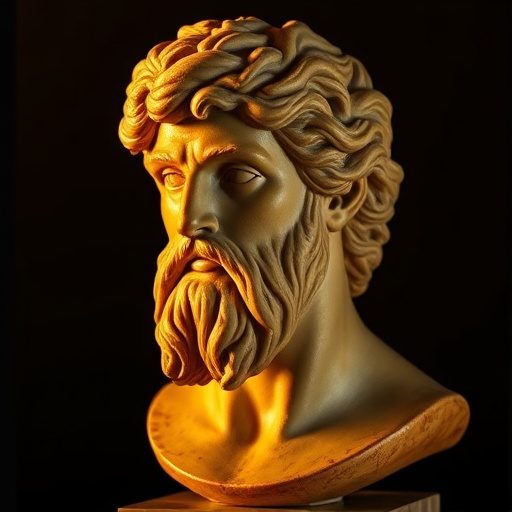
Pythagoras — "Do not go to bed until you have gone over the day three times in your mind. What…"
Do not go to bed until you have gone over the day three times in your mind. What did I do wrong? What did I do right? What did I leave undone?
Do not go to bed until you have gone over the day three times in your mind. What did I do wrong? What did I do right? What did I leave undone?
Click any product to generate a realistic preview. Up to 3 at a time.
* Initial load can take up to 90 seconds — revising the preview in another color is nearly instant.
"Leave not a trace of the pot in the ashes."
"All things are numbers."
"Time is the soul of this world."
"Anger begins with folly and ends with repentance."
"Don't mix a fire with a knife."
Greek philosopher and mathematician whose school in Croton combined geometry (the Pythagorean theorem), number-mysticism, and a religious-vegetarian way of life. Closely associated with Thales of Miletus (earlier pre-Socratic and the first philosopher). For an intellectual contrast, see Heraclitus, pre-Socratic Greek philosopher of flux — Heraclitus called Pythagoras 'the chief of swindlers' — among the founding insults of the philosophical-rivalry tradition. Their 'all is flux' vs 'all is number' poles still organize the philosophy of mathematics today (Platonist vs anti-realist).
Found in 1 providers: deepseek
1 source checked
Before sleeping, mentally replay your entire day three times, asking three pointed questions: where did I fail, where did I succeed, and what did I neglect to finish? It is a disciplined self-audit practice, demanding honest self-confrontation rather than passive rest. The repetition of three implies thoroughness, not casual reflection, treating each day as a moral and practical ledger requiring deliberate review.
Pythagoras founded a secretive philosophical brotherhood in Croton that governed members' daily lives through strict rules, rituals, and ethical codes. This quote mirrors that communal discipline: members were expected to practice memory exercises and moral self-examination nightly. His belief that numbers and order governed the cosmos extended to personal conduct, making methodical daily review consistent with his core teaching that harmony requires conscious, repeated effort.
In ancient Greece around 500 BCE, there were no written personal journals or institutional accountability systems. Memory was the primary cognitive tool for learning and self-governance. Philosophers like Pythagoras operated in oral traditions where reflection and recitation were serious intellectual practices. His era also saw the rise of ethical philosophy asking how humans should live, making structured self-examination a radical civic and spiritual discipline rather than mere habit.
AI-generated insights based on extensive research and information for context. Factual errors? Email [email protected].
Your cart is empty