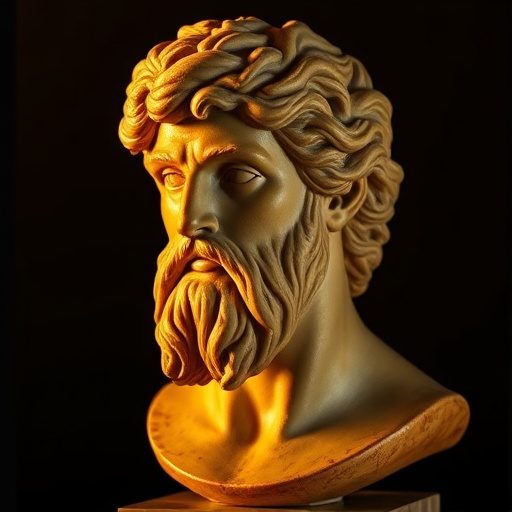
Pythagoras — "Spit upon the parings of your nails, and the clippings of your hair."
Spit upon the parings of your nails, and the clippings of your hair.
Spit upon the parings of your nails, and the clippings of your hair.
Click any product to generate a realistic preview. Up to 3 at a time.
* Initial load can take up to 90 seconds — revising the preview in another color is nearly instant.
"The soul of man is immortal and that it changes into other kinds of animals."
"Do not look in a mirror by lamplight."
"The oldest and shortest words, 'yes' and 'no,' are those which require the most thought."
"The earth is a sphere."
"Numbers rule the universe."
Greek philosopher and mathematician whose school in Croton combined geometry (the Pythagorean theorem), number-mysticism, and a religious-vegetarian way of life. Closely associated with Thales of Miletus (earlier pre-Socratic and the first philosopher). For an intellectual contrast, see Heraclitus, pre-Socratic Greek philosopher of flux — Heraclitus called Pythagoras 'the chief of swindlers' — among the founding insults of the philosophical-rivalry tradition. Their 'all is flux' vs 'all is number' poles still organize the philosophy of mathematics today (Platonist vs anti-realist).
A Pythagorean 'Symbol', interpreted as leaving one's 'old, dead life' behind or having an occult meaning.
Date: c. 570-495 BCE (interpreted later)
WisdomFound in 1 providers: gemini
1 source checked
Spit on your nail clippings and hair cuttings before discarding them. The instruction warns that detached body parts stay magically connected to you — anyone who collects them could use them to cast harm on you through sympathetic magic. Spitting was a recognized ritual act that neutralized this danger. In plain terms: don't carelessly leave physical traces of yourself where enemies can exploit them.
Pythagoras led a secretive brotherhood in Croton, southern Italy, governed by dozens of cryptic ritual rules called akousmata — 'things heard.' These prescriptions covered diet, gesture, and daily conduct, rooted in his doctrine of metempsychosis (soul transmigration) and bodily purity. This saying fits perfectly: his school was as much a mystery cult as a philosophy, and he treated the body as a vessel carrying sacred, persistent power requiring careful stewardship.
In 6th-century BCE Magna Graecia, sympathetic magic — the belief that hair, nails, or blood could be used to curse someone at a distance — was taken as practical reality, not superstition. Archaeological finds of lead curse tablets (defixiones) confirm the practice was widespread. Ritual spitting was a recognized apotropaic act. In this environment, Pythagoras's instruction was serious protective advice, consistent with how Greek mystery cults integrated spiritual discipline into every physical detail of life.
AI-generated insights based on extensive research and information for context. Factual errors? Email [email protected].
Your cart is empty