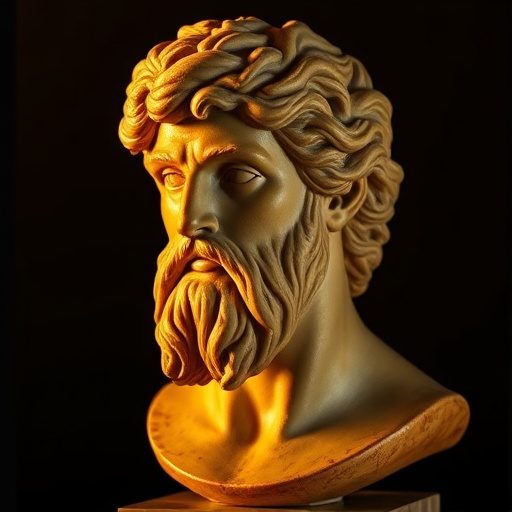
Pythagoras — "Do not receive a weasel into your house."
Do not receive a weasel into your house.
Do not receive a weasel into your house.
Click any product to generate a realistic preview. Up to 3 at a time.
* Initial load can take up to 90 seconds — revising the preview in another color is nearly instant.
"In no way neglect the health of your body; But give it drink and food in due measure, and also the exercise of which it has need."
"Avoid all things that will occasion envy."
"Abstain from flesh."
"Abstain from animals."
"Above the cloud with its shadow is the star with its light."
Greek philosopher and mathematician whose school in Croton combined geometry (the Pythagorean theorem), number-mysticism, and a religious-vegetarian way of life. Closely associated with Thales of Miletus (earlier pre-Socratic and the first philosopher). For an intellectual contrast, see Heraclitus, pre-Socratic Greek philosopher of flux — Heraclitus called Pythagoras 'the chief of swindlers' — among the founding insults of the philosophical-rivalry tradition. Their 'all is flux' vs 'all is number' poles still organize the philosophy of mathematics today (Platonist vs anti-realist).
One of the 'symbols,' possibly an allegory against accepting deceitful or harmful individuals.
Date: c. 570 – c. 495 BC
ShockingFound in 1 providers: grok
1 source checked
Don't let untrustworthy, sneaky, or gossipy people into your inner circle. A weasel represents someone who steals, pries, and causes small but persistent damage. The saying warns against granting access or intimacy to those whose character is cunning and predatory, because once inside they will disrupt the household, spread rumors, and betray confidences. Choose carefully whom you allow close.
Pythagoras led a tight-knit philosophical brotherhood in Croton where members shared property, took vows of silence, and underwent years of probation before admission. Trust and discretion were everything; leaked teachings could destroy the order. This symbolic maxim fits his famous akousmata, cryptic rules guarding community purity. Screening newcomers against treacherous character matched his belief that moral harmony, like mathematical ratio, depended on excluding disruptive elements.
In 6th-century BCE Greek and Magna Graecia society, households were economic fortresses where servants, guests, and kin mingled freely, and weasels were kept indoors to hunt mice. Political factions, tyrants, and rival sects routinely planted informants. Pythagoras's Croton brotherhood eventually faced violent persecution partly through betrayal from within. Oral wisdom traveled as riddling proverbs, and hospitality codes carried heavy weight, making warnings about dangerous guests culturally urgent and instantly understood.
AI-generated insights based on extensive research and information for context. Factual errors? Email [email protected].
Your cart is empty