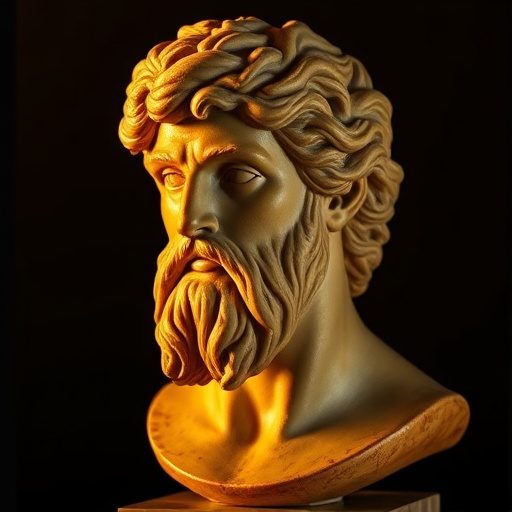
Pythagoras — "Abstain from flesh."
Abstain from flesh.
Abstain from flesh.
Click any product to generate a realistic preview. Up to 3 at a time.
* Initial load can take up to 90 seconds — revising the preview in another color is nearly instant.
"Eat not the brain."
"Accustom yourself to a way of living that is neat and decent without luxury."
"Leave not a trace of the pot in the ashes."
"Don't wipe up a mess with a torch."
"Do not wear a ring."
Greek philosopher and mathematician whose school in Croton combined geometry (the Pythagorean theorem), number-mysticism, and a religious-vegetarian way of life. Closely associated with Thales of Miletus (earlier pre-Socratic and the first philosopher). For an intellectual contrast, see Heraclitus, pre-Socratic Greek philosopher of flux — Heraclitus called Pythagoras 'the chief of swindlers' — among the founding insults of the philosophical-rivalry tradition. Their 'all is flux' vs 'all is number' poles still organize the philosophy of mathematics today (Platonist vs anti-realist).
Pythagoreans were known for their vegetarianism, based on the belief in metempsychosis (transmigration of souls).
Date: c. 570 – c. 495 BC
ShockingFound in 1 providers: grok
1 source checked
Eat no animal meat. The directive calls for a vegetarian way of life, grounded in the belief that consuming flesh is morally or spiritually harmful. Beyond diet, it signals a commitment to non-violence toward living creatures. In modern terms, it anticipates ethical vegetarianism: the idea that animals deserve not to be killed for food, and that what we eat reflects our deepest values.
Pythagoras founded a religious-philosophical brotherhood at Croton with strict communal rules, and vegetarianism was central to it. He believed in metempsychosis—the transmigration of souls between humans and animals—meaning the animal on your plate might house a human soul. His followers were so associated with meatless eating that for centuries 'Pythagorean diet' was the standard term for vegetarianism, predating the modern word by two millennia.
In 6th-century BCE Greece, animal sacrifice was the backbone of public religion: you killed an animal, offered it to the gods, and the community feasted on the meat. To abstain from flesh was to refuse this civic and religious ritual entirely—a radical act. Mystery religions like Orphism were also questioning traditional sacrifice. Pythagoras's rule stood against dominant culture, framing diet as a spiritual discipline in an age when meat-eating was inseparable from worship.
AI-generated insights based on extensive research and information for context. Factual errors? Email [email protected].
Your cart is empty