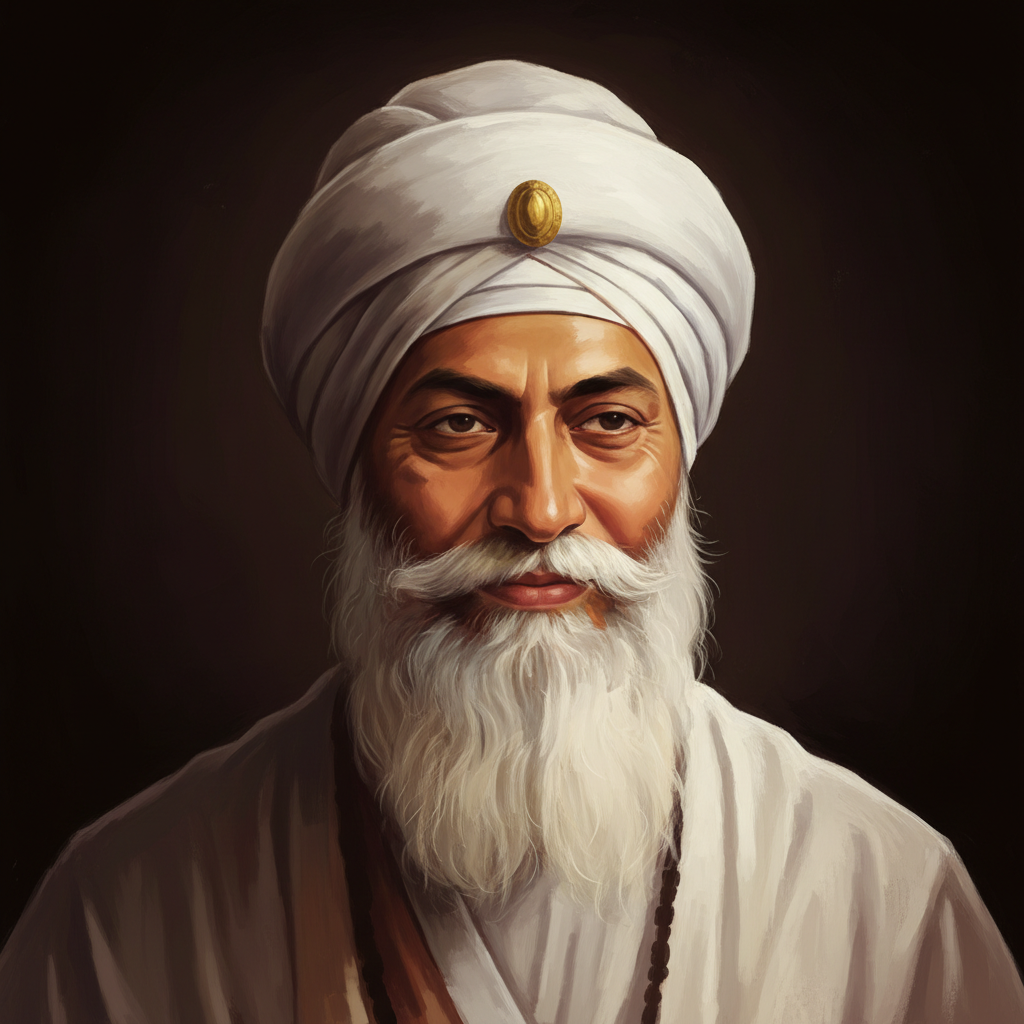
Guru Nanak — "Do not speak ill of anyone, for God dwells in every heart."
Do not speak ill of anyone, for God dwells in every heart.
Do not speak ill of anyone, for God dwells in every heart.
Click any product to generate a realistic preview. Up to 3 at a time.
* Initial load can take up to 90 seconds — revising the preview in another color is nearly instant.
"The world is suffering in falsehood, and only truth can save it."
"He who considers himself humble, he alone is worthy of praise."
"Without the True Guru, none obtains salvation."
"The greatest wisdom is to know God. The second greatest is to know where you left your reading glasses."
"May peace prevail on Earth. And may my noisy neighbors finally get some headphones."
Founder of Sikhism and the first of the Ten Sikh Gurus, whose teachings of one universal God and rejection of caste shaped Punjab. Closely associated with Kabir (mystical poet whose verses appear in the Sikh Guru Granth Sahib). For an intellectual contrast, see Brahmanical orthodoxy, the Hindu caste-and-ritual establishment of his era — Sikhism was founded as a deliberate alternative to both Hindu ritual hierarchy and Islamic exclusivism — Nanak's universalism was a structural rejection of caste and priestly mediation.
Found in 1 providers: gemini
1 source checked
This saying urges people to stop gossiping, insulting, or tearing others down with their words. The reasoning is spiritual rather than social: if a divine presence lives inside every person, then mocking or slandering anyone is effectively directed at that sacred presence. It asks the speaker to see each human being, even enemies or strangers, as carrying something holy, and to let that recognition govern everyday speech and judgment.
Guru Nanak founded Sikhism around 1500 on the radical principle of Ik Onkar, one divine reality present in all creation. He rejected caste, gender, and religious hierarchies, famously declaring there is no Hindu and no Muslim, only humans. As a traveling teacher who ate with outcastes and debated priests of every faith, he practiced what this line preaches: treating every person's heart as a seat of God demanded respectful speech above all.
Guru Nanak lived from 1469 to 1539 in Punjab, during the collapse of the Delhi Sultanate and the rise of Babur's Mughal Empire. Hindu-Muslim tension was sharp, caste untouchability was enforced, and religious communities routinely slandered each other's beliefs and prophets. Into this climate of sectarian insult and social contempt, Nanak preached a single humanity under one God, making the command against speaking ill of anyone a direct rebuke of his era's communal hatred.
AI-generated insights based on extensive research and information for context. Factual errors? Email [email protected].
Your cart is empty