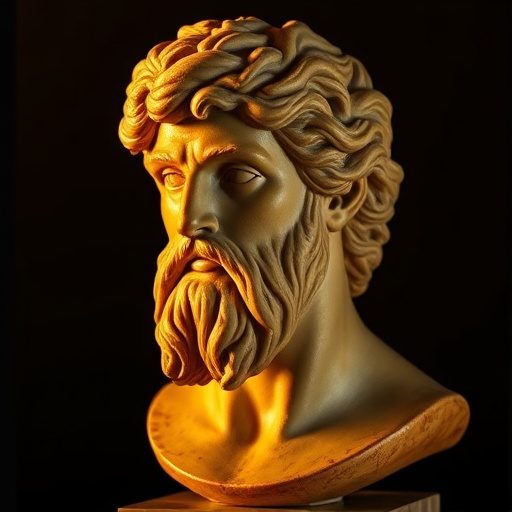
Pythagoras — "Don't piss or stand on your cut nails and hair."
Don't piss or stand on your cut nails and hair.
Don't piss or stand on your cut nails and hair.
Click any product to generate a realistic preview. Up to 3 at a time.
* Initial load can take up to 90 seconds — revising the preview in another color is nearly instant.
"Do not break bread."
"The beginning is half of the whole."
"It is only necessary to make war with five things; with the maladies of the body, the ignorances of the mind, with the passions of the body, with the seditions of the city and the discords of families…"
"A fool is known by his speech, and a wise man by silence."
"When abroad, don't turn back at the border."
Greek philosopher and mathematician whose school in Croton combined geometry (the Pythagorean theorem), number-mysticism, and a religious-vegetarian way of life. Closely associated with Thales of Miletus (earlier pre-Socratic and the first philosopher). For an intellectual contrast, see Heraclitus, pre-Socratic Greek philosopher of flux — Heraclitus called Pythagoras 'the chief of swindlers' — among the founding insults of the philosophical-rivalry tradition. Their 'all is flux' vs 'all is number' poles still organize the philosophy of mathematics today (Platonist vs anti-realist).
A Pythagorean 'Symbol', interpreted as repudiating the 'dead products of the physical body' or having occult meaning.
Date: c. 570-495 BCE (interpreted later)
WisdomFound in 1 providers: gemini
1 source checked
Discard your cut nails and hair carefully — don't urinate on them or leave them where they can be trampled. Body remnants retain a spiritual link to you; mishandling them invites harm through sympathetic magic or pollutes sacred space. The precept is about ritual hygiene and respect for cast-off body parts, treating them as still spiritually connected to you rather than mere trash.
Pythagoras led a religious brotherhood at Croton with strict purity codes called akousmata — cryptic oral rules covering diet, ritual, and daily conduct. He taught metempsychosis: souls transmigrate between bodies, making bodily integrity spiritually significant. His mathematics revealed cosmic order; his ethics demanded living in harmony with that order. This nail-and-hair rule is one of dozens of such prohibitions followers memorized, reflecting his fusion of mystical religion with disciplined communal life.
Ancient Greeks in the 6th century BCE believed cut hair and nails retained sympathetic connection to their owner — sorcerers could use them in binding spells and curses. Mystery religions like Orphism, which strongly influenced Pythagoras, demanded ritual purity at every level. The Pythagorean community at Croton operated amid competing cults and civic tensions; bodily taboos reinforced group identity, protected members from magical attack, and signaled devotion to a pure, ordered way of life.
AI-generated insights based on extensive research and information for context. Factual errors? Email [email protected].
Your cart is empty