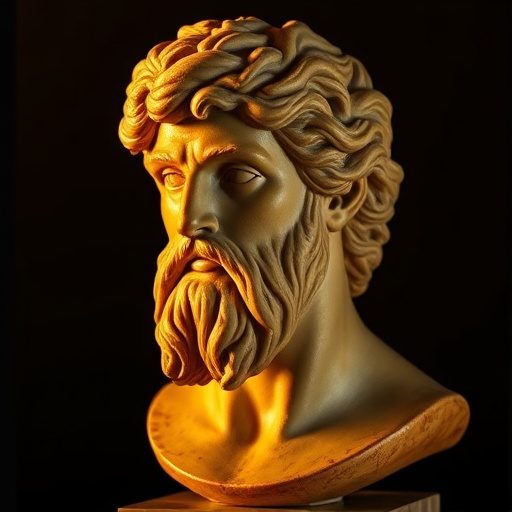
Pythagoras — "The beginning is half of the whole."
The beginning is half of the whole.
The beginning is half of the whole.
Click any product to generate a realistic preview. Up to 3 at a time.
* Initial load can take up to 90 seconds — revising the preview in another color is nearly instant.
"Eating beans is the same as eating the heads of one's parents."
"It is better to be silent, than to dispute with the Ignorant."
"Don't walk on the highway."
"The stars in the heavens sing a music if only we had ears to hear."
"In anger we should refrain both from speech and action."
Greek philosopher and mathematician whose school in Croton combined geometry (the Pythagorean theorem), number-mysticism, and a religious-vegetarian way of life. Closely associated with Thales of Miletus (earlier pre-Socratic and the first philosopher). For an intellectual contrast, see Heraclitus, pre-Socratic Greek philosopher of flux — Heraclitus called Pythagoras 'the chief of swindlers' — among the founding insults of the philosophical-rivalry tradition. Their 'all is flux' vs 'all is number' poles still organize the philosophy of mathematics today (Platonist vs anti-realist).
Found in 2 providers: deepseek,grok
2 sources checked
Starting is the hardest part — and doing it means you've already covered half the distance. Once you commit to beginning, momentum builds, obstacles shrink, and the path forward clarifies. The mental barrier before action is often greater than the work itself. Taking that first real step transforms a vague intention into something with trajectory and a genuine chance of completion.
Pythagoras built everything on first principles — his proofs began with axioms, his theorems from foundational relationships. He founded a secretive brotherhood in Croton around 530 BCE where initiation rituals marked the beginning of membership, and he believed the cosmos ran on numerical relationships established at creation. For him, the originating principle defined everything that followed, whether in mathematics, music harmonics, or the soul's journey toward understanding.
Pythagoras lived in 6th-century BCE Greece, an era of explosive intellectual awakening when thinkers were replacing mythological explanations with rational ones. Greek colonists were literally founding new city-states, so beginnings mattered politically and spiritually. The concept of arche — the first principle — dominated Pre-Socratic philosophy. Thales, Anaximander, and Anaximenes each sought the original substance from which all else arose, making this era especially attuned to the power of foundations and origins.
AI-generated insights based on extensive research and information for context. Factual errors? Email [email protected].
Your cart is empty