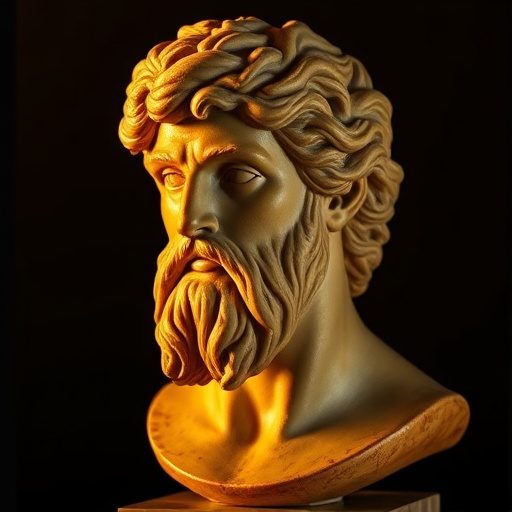
Pythagoras — "Don't piss towards the sun."
Don't piss towards the sun.
Don't piss towards the sun.
Click any product to generate a realistic preview. Up to 3 at a time.
* Initial load can take up to 90 seconds — revising the preview in another color is nearly instant.
"Do not go to bed until you have gone over the day three times in your mind. What wrong did I do? What good did I accomplish? What did I forget to do?"
"Respect yourself, and others will respect you."
"Friendship is one soul in two bodies."
"The monad, is god and the good, which is the origin of the One, and is itself intelligence; but the undefined dyad is a deity and the evil, surrounding which is the mass of matter."
"There are men and gods, and beings like Pythagoras."
Greek philosopher and mathematician whose school in Croton combined geometry (the Pythagorean theorem), number-mysticism, and a religious-vegetarian way of life. Closely associated with Thales of Miletus (earlier pre-Socratic and the first philosopher). For an intellectual contrast, see Heraclitus, pre-Socratic Greek philosopher of flux — Heraclitus called Pythagoras 'the chief of swindlers' — among the founding insults of the philosophical-rivalry tradition. Their 'all is flux' vs 'all is number' poles still organize the philosophy of mathematics today (Platonist vs anti-realist).
A Pythagorean 'Symbol', possibly indicating respect for divine entities or practical hygiene.
Date: c. 570-495 BCE (interpreted later)
WisdomFound in 1 providers: gemini
1 source checked
Don't do something crude or disrespectful toward what is greater and sacred. Taken literally as a hygiene rule, it also encodes a broader principle: maintain dignity and reverence before powerful forces. Don't act with arrogance or crudeness toward things that command respect. Know what deserves reverence and don't debase yourself before it — hubris against the sacred invites consequences.
Pythagoras led a strict religious brotherhood governed by hundreds of ritual codes called akousmata — behavioral taboos covering diet, speech, and bodily conduct. He viewed celestial bodies as divine mathematical entities; the sun held sacred status in his cosmology. This saying reflects his fusion of practical discipline, religious piety, and cosmic reverence, hallmarks of a man who believed purifying behavior was inseparable from understanding the universe's mathematical order.
In 6th-century BCE Greece, the sun was worshipped as the god Helios, and ritual purity was central to religious life. Pythagoreans lived in tightly governed communities in southern Italy where behavioral codes enforced collective purity. Bodily irreverence toward sacred things carried genuine religious weight, not mere social embarrassment. Separating philosophy from religion was unthinkable — cosmic observation, ritual conduct, and mathematical inquiry were unified disciplines in Pythagorean practice.
AI-generated insights based on extensive research and information for context. Factual errors? Email [email protected].
Your cart is empty