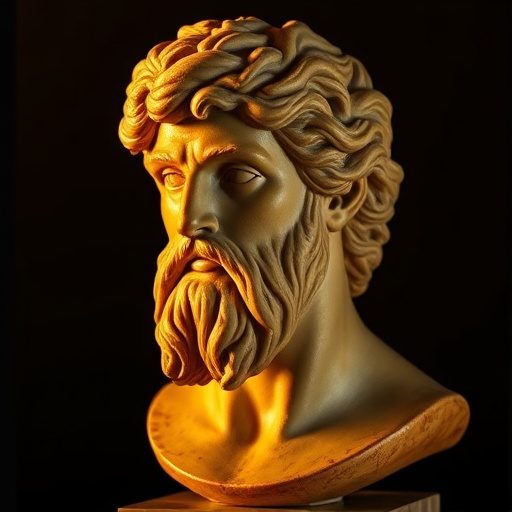
Pythagoras — "Friendship is one soul in two bodies."
Friendship is one soul in two bodies.
Friendship is one soul in two bodies.
Click any product to generate a realistic preview. Up to 3 at a time.
* Initial load can take up to 90 seconds — revising the preview in another color is nearly instant.
"The earth is a sphere."
"Don't leave the outline of a pan in ashes."
"Pythagoras once claimed he had been reincarnated multiple times and was the son of Hermes, who gifted him the power of remembering who he was in all of his past lives."
"The soul of man is divided into three parts, intelligence, reason, and passion. Intelligence and passion are possessed by other animals, but reason by man alone."
"Truth is so great a perfection, that if God would render himself visible to men, he would choose light for his body and truth for his soul."
Greek philosopher and mathematician whose school in Croton combined geometry (the Pythagorean theorem), number-mysticism, and a religious-vegetarian way of life. Closely associated with Thales of Miletus (earlier pre-Socratic and the first philosopher). For an intellectual contrast, see Heraclitus, pre-Socratic Greek philosopher of flux — Heraclitus called Pythagoras 'the chief of swindlers' — among the founding insults of the philosophical-rivalry tradition. Their 'all is flux' vs 'all is number' poles still organize the philosophy of mathematics today (Platonist vs anti-realist).
A poetic and profound definition of true friendship, often attributed to him.
Date: c. 5th Century BCE
PhilosophicalFound in 1 providers: gemini
1 source checked
True friendship is a deep union where two people share a single inner life. Their thoughts, values, and feelings align so closely that, despite being separate individuals, they move and respond as one. It goes beyond convenience or affection: real friends understand each other instinctively, want the same goods for one another, and treat each other's joys and sufferings as their own experiences.
Pythagoras founded a tight-knit brotherhood in Croton where members pooled property, kept shared secrets, and followed identical dietary and spiritual rules. For him, friendship was not sentiment but structural: a disciplined harmony between souls pursuing truth together. This saying mirrors his belief in numerical unity and cosmic concord, and it shaped his community's vow that 'a friend is another self,' later echoed by Aristotle.
In 6th-century BCE Greece, loyalties were tribal, transactional, or tied to the polis. Pythagoras lived amid colonial city-states in southern Italy marked by political factionalism and aristocratic rivalries. Philosophical brotherhoods were a new phenomenon, offering an alternative bond based on shared reason rather than blood or citizenship. Framing friendship as spiritual union was radical, elevating private relationships to the moral seriousness previously reserved for civic or religious duty.
AI-generated insights based on extensive research and information for context. Factual errors? Email [email protected].
Your cart is empty