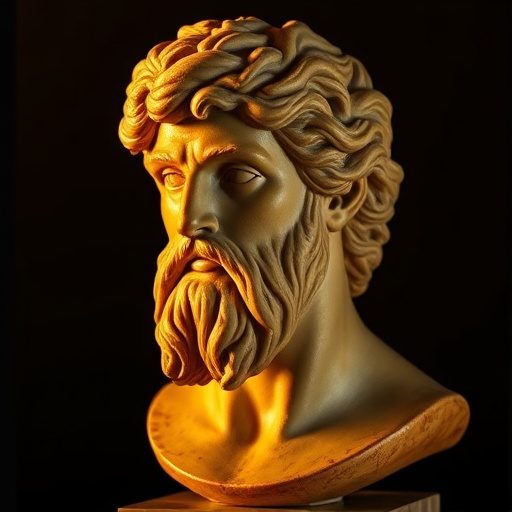
Pythagoras — "Don't wipe up a mess with a torch."
Don't wipe up a mess with a torch.
Don't wipe up a mess with a torch.
Click any product to generate a realistic preview. Up to 3 at a time.
* Initial load can take up to 90 seconds — revising the preview in another color is nearly instant.
"Men must be taught as if you taught them not, and things unknown proposed as things forgot."
"Number is the within of all things."
"Do not speak without light."
"It is better to be silent than to utter words that are not true."
"The property of friends is common."
Greek philosopher and mathematician whose school in Croton combined geometry (the Pythagorean theorem), number-mysticism, and a religious-vegetarian way of life. Closely associated with Thales of Miletus (earlier pre-Socratic and the first philosopher). For an intellectual contrast, see Heraclitus, pre-Socratic Greek philosopher of flux — Heraclitus called Pythagoras 'the chief of swindlers' — among the founding insults of the philosophical-rivalry tradition. Their 'all is flux' vs 'all is number' poles still organize the philosophy of mathematics today (Platonist vs anti-realist).
A Pythagorean 'Symbol', possibly a practical warning or symbolic of not using something sacred for mundane tasks.
Date: c. 570-495 BCE (interpreted later)
WisdomFound in 1 providers: gemini
1 source checked
Don't solve a small problem with a method so destructive it makes everything worse. A torch used to wipe up a spill ignites the whole room. The message is about proportionality — match the scale of your remedy to the scale of the problem. Overkill doesn't fix things; it transforms manageable messes into catastrophes. Apply the right tool at the right intensity, nothing more.
Pythagoras taught through cryptic sayings called akusmata — symbolic prohibitions for his secretive brotherhood at Croton, Italy. He believed number and proportion governed the cosmos: everything in right relationship. This saying embodies that core principle — proportion between problem and remedy. His mathematical work on ratios and harmonic intervals reflected the same logic: mismatch produces discord. A thinker who saw the universe as ordered ratios would naturally warn against wildly disproportionate responses.
In 6th-century BCE Magna Graecia, Pythagoras led a disciplined philosophical commune where cryptic sayings trained initiates in measured conduct. Fire was simultaneously sacred — used in altar rituals — and existential threat; wooden cities had no suppression technology, and a careless flame could erase a community overnight. These akusmata carried immediate, visceral weight. Recklessness with fire wasn't metaphor — it was the real mechanism by which poor judgment destroyed everything around it.
AI-generated insights based on extensive research and information for context. Factual errors? Email [email protected].
Your cart is empty