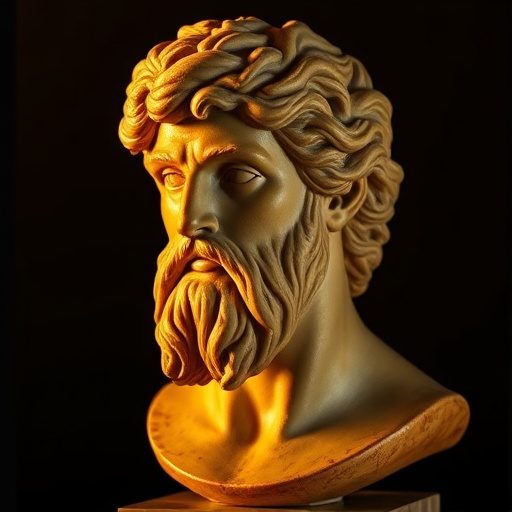
Pythagoras — "The property of friends is common."
The property of friends is common.
The property of friends is common.
Click any product to generate a realistic preview. Up to 3 at a time.
* Initial load can take up to 90 seconds — revising the preview in another color is nearly instant.
"The soul is a self-moving number."
"The number seven held a sacred meaning since it correlated with the number of classical planets... as well as the number of strings on a lyre."
"Five represents marriage because it is the sum of two and three (the Pythagoreans believed that even numbers were masculine and odd numbers were feminine)."
"It is difficult to walk at one and the same time many paths of life."
"The earth is a sphere."
Greek philosopher and mathematician whose school in Croton combined geometry (the Pythagorean theorem), number-mysticism, and a religious-vegetarian way of life. Closely associated with Thales of Miletus (earlier pre-Socratic and the first philosopher). For an intellectual contrast, see Heraclitus, pre-Socratic Greek philosopher of flux — Heraclitus called Pythagoras 'the chief of swindlers' — among the founding insults of the philosophical-rivalry tradition. Their 'all is flux' vs 'all is number' poles still organize the philosophy of mathematics today (Platonist vs anti-realist).
Reflects the communal aspect of the Pythagorean brotherhood.
Date: c. 570 – c. 495 BC
ShockingFound in 1 providers: grok
1 source checked
True friendship erases strict lines of ownership. When people genuinely care for one another, what belongs to one is freely available to the other, whether money, food, shelter, or time. Friends do not keep score or guard possessions jealously against each other. Real closeness means sharing resources as naturally as sharing thoughts, trusting that generosity flows both ways without needing repayment tracked or boundaries enforced between them.
Pythagoras founded a tight-knit philosophical brotherhood in Croton where members literally pooled their possessions upon joining. Initiates surrendered private wealth to a communal treasury, ate shared meals, and followed collective rules. This saying is not abstract theory for him but the organizing principle of his school. His mathematical work on harmony and ratio mirrored his social conviction that proper human bonds required balanced, shared contribution rather than individual accumulation.
In 6th-century BCE Greece, private property and household autonomy were bedrocks of the polis, with inheritance and land ownership defining citizenship. Aristocratic competition over wealth drove civic life. Pythagoras's communal experiment at Croton directly challenged this, proposing a radical alternative that later influenced Plato's Republic. The idea circulated widely enough to become proverbial, quoted by Aristotle and Plato as a recognized philosophical maxim about ideal friendship.
AI-generated insights based on extensive research and information for context. Factual errors? Email [email protected].
Your cart is empty