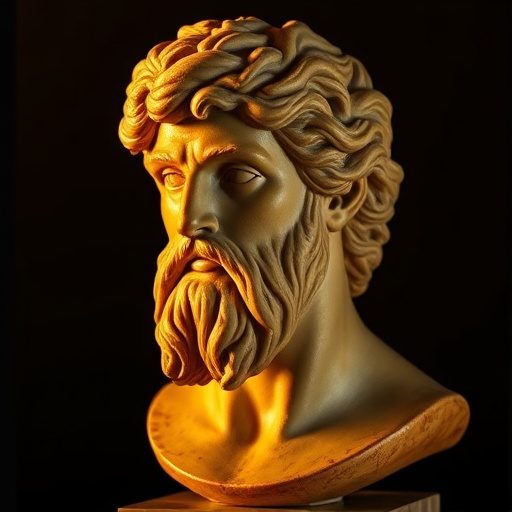
Pythagoras — "Men must be taught as if you taught them not, and things unknown proposed as thi…"
Men must be taught as if you taught them not, and things unknown proposed as things forgot.
Men must be taught as if you taught them not, and things unknown proposed as things forgot.
Click any product to generate a realistic preview. Up to 3 at a time.
* Initial load can take up to 90 seconds — revising the preview in another color is nearly instant.
"Do not wear a tight shoe."
"Every man has been made by God in order to acquire knowledge and contemplate."
"Do not cut your nails on holy days."
"Abstain from the flesh of beasts that die of themselves."
"The square of the hypotenuse of a right-angled triangle is equal to the sum of the squares of the other two sides."
Greek philosopher and mathematician whose school in Croton combined geometry (the Pythagorean theorem), number-mysticism, and a religious-vegetarian way of life. Closely associated with Thales of Miletus (earlier pre-Socratic and the first philosopher). For an intellectual contrast, see Heraclitus, pre-Socratic Greek philosopher of flux — Heraclitus called Pythagoras 'the chief of swindlers' — among the founding insults of the philosophical-rivalry tradition. Their 'all is flux' vs 'all is number' poles still organize the philosophy of mathematics today (Platonist vs anti-realist).
Found in 1 providers: grok
1 source checked
Effective teaching works best when it doesn't feel like teaching. Present new ideas as though the learner already knows them, gently drawing knowledge out rather than forcing it in. When someone feels lectured at, they resist; when they feel reminded of something familiar, they engage. Good instruction disguises itself as conversation, and unfamiliar concepts land more easily when framed as rediscoveries rather than corrections or impositions from an authority figure.
Pythagoras ran a secretive philosophical brotherhood in Croton where initiates learned through graduated stages, oral transmission, and years of silent listening before speaking. He believed souls were immortal and carried knowledge across lifetimes, so learning was literally recollection. This pedagogical stance, treating instruction as drawing out dormant truth rather than depositing new information, fits his mystical-mathematical worldview and later directly influenced Plato's theory of anamnesis.
In 6th-century BCE Greece, formal education was rare and knowledge passed through apprenticeship, poetry recitation, or religious mystery cults. Pythagoras founded his school around 530 BCE in southern Italy during a period of colonial expansion, political upheaval, and intellectual ferment that also produced Thales, Anaximander, and early Ionian philosophy. Written texts were scarce, so teaching depended on memory, dialogue, and gradual initiation, making subtle, respectful pedagogy both practical and spiritually meaningful.
AI-generated insights based on extensive research and information for context. Factual errors? Email [email protected].
Your cart is empty