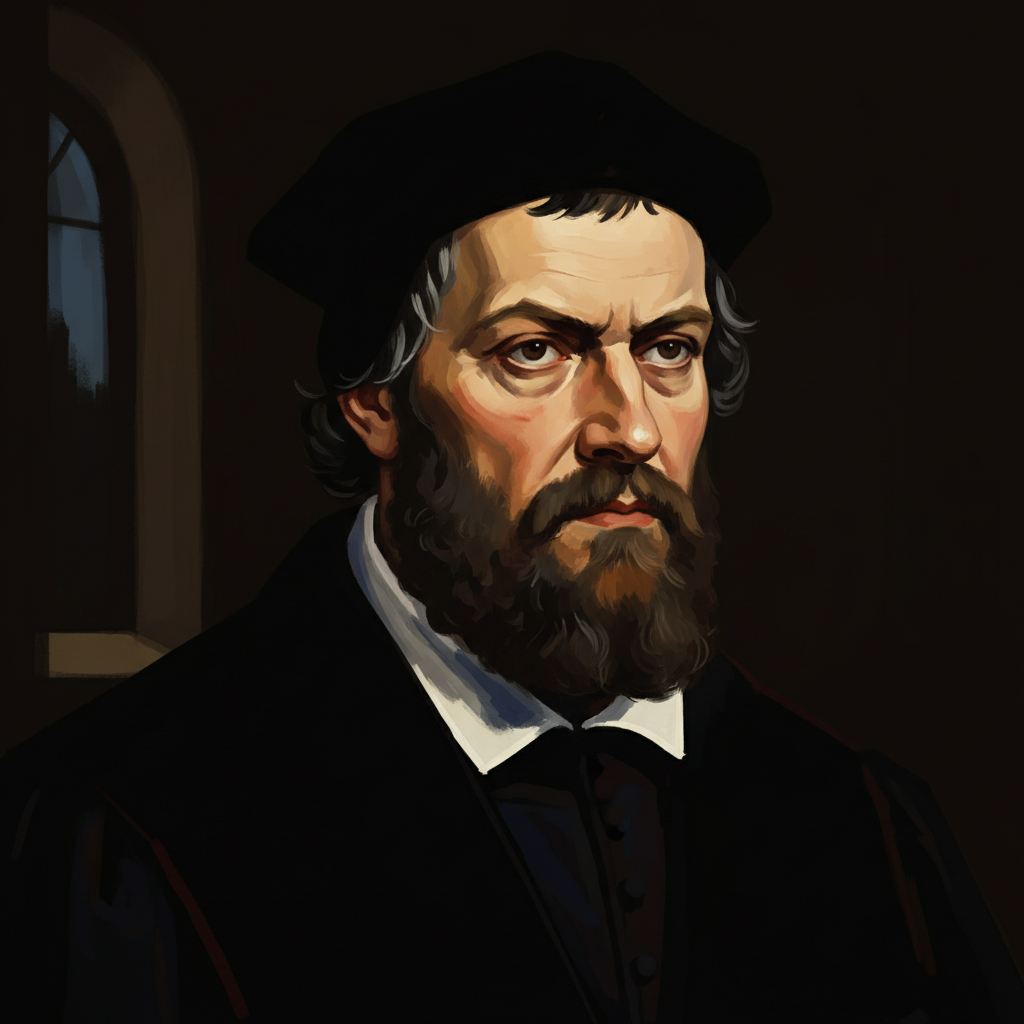
Martin Luther — "Drinking and eating are the highest pleasures."
Drinking and eating are the highest pleasures.
Drinking and eating are the highest pleasures.
Click any product to generate a realistic preview. Up to 3 at a time.
* Initial load can take up to 90 seconds — revising the preview in another color is nearly instant.
"Printing is the ultimate gift of God and the greatest one. Indeed, the invention of printing is the work of God."
"Beer is made by men, wine by God."
"The hair is the finest ornament a woman has. If she be a virgin, let her wear it loose; if married, let her wear it up."
"The greatest vice is pride."
"I have been so busy with writing that I have not had time to pray."
German theologian whose 95 Theses (1517) launched the Protestant Reformation and broke the Catholic Church's monopoly on Western Christianity. Closely associated with Philipp Melanchthon (Lutheran systematizer) and John Calvin (later Reformer who built on Luther's break). For an intellectual contrast, see Pope Leo X, Renaissance pope (1513-1521) — Leo X's indulgence sales triggered Luther's break and Leo excommunicated him in 1521 — Luther's entire Reformation is structured as a direct answer to the indulgence-funded Vatican Leo represented.
Found in 1 providers: grok
1 source checked
The quote asserts that the simple bodily enjoyments of food and drink rank at the top of human satisfactions. It rejects the idea that spiritual austerity or intellectual achievement must outrank ordinary sensory pleasure. In modern terms, a good meal and a good drink are legitimate, even supreme, sources of happiness, and there is no shame in ranking them highly among life's rewards.
Luther, a former Augustinian monk who had lived under vows of fasting and self-denial, famously broke with monastic austerity after 1517. He married the ex-nun Katharina von Bora, raised a boisterous household, and was renowned for hearty beer-drinking and frank table talk recorded in his Tischreden. His theology of justification by faith freed him to treat eating and drinking as gifts from God rather than obstacles to holiness.
In early-sixteenth-century Europe, medieval Catholic piety still prized fasting, celibacy, and mortification of the flesh as marks of sanctity. The Protestant Reformation Luther launched in 1517 challenged that ascetic economy, rejecting monastic vows and reaffirming ordinary domestic life. Meanwhile German drinking culture, centered on beer and long tavern suppers, was flourishing, and Luther's Wittenberg table became a cultural institution where reformers ate, drank, and debated theology openly.
AI-generated insights based on extensive research and information for context. Factual errors? Email [email protected].
Your cart is empty