What it means
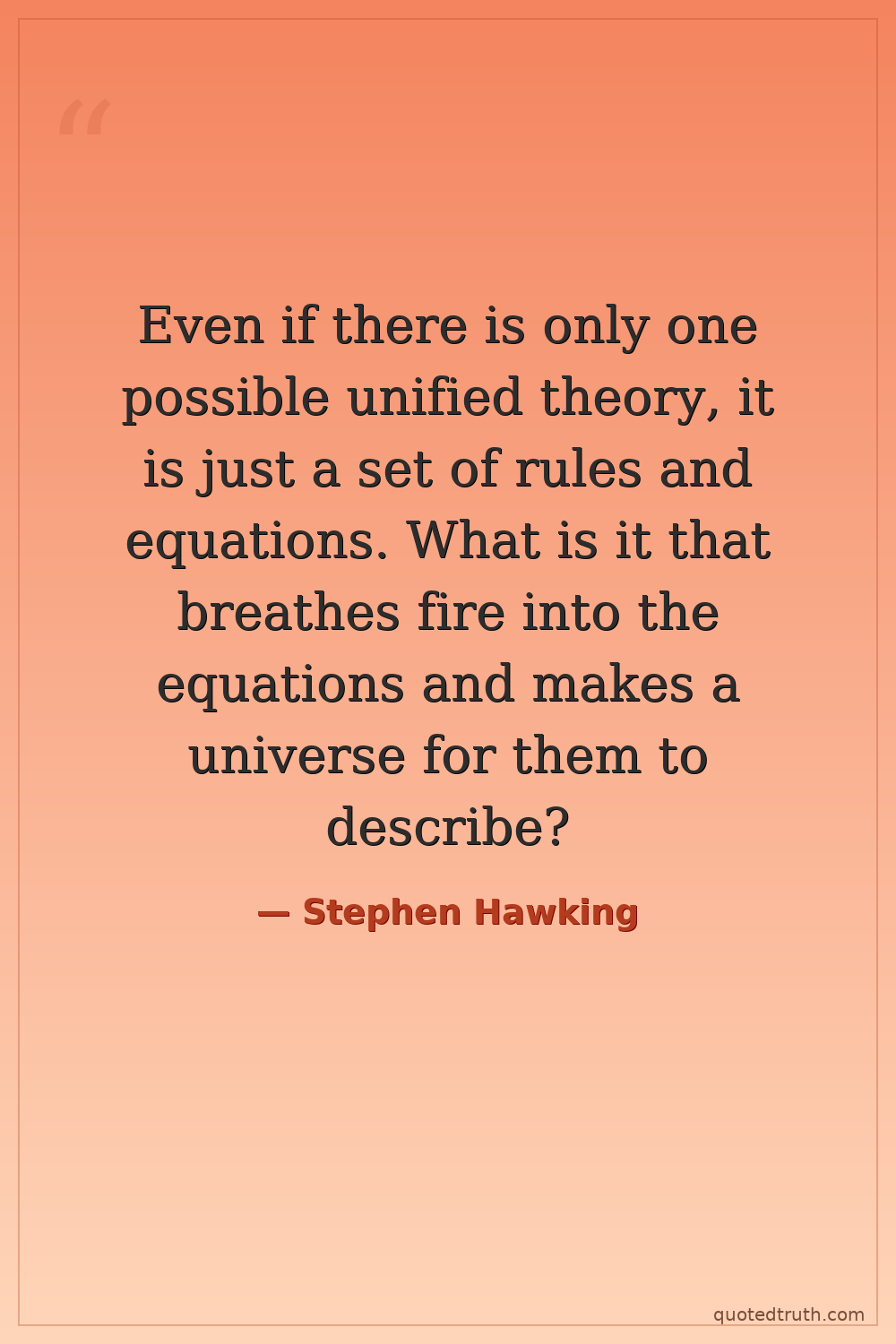
This quote probes philosophy's hardest problem: even a perfect mathematical theory of the universe cannot explain why anything exists at all. Mathematics describes relationships and patterns, but equations don't spontaneously generate reality. Hawking asks what force or principle transforms abstract math into a living, physical cosmos — pointing at a gap physics alone cannot close, challenging scientists who believe finding the right equations would fully explain existence.
Relevance to Stephen Hawking
Hawking devoted his life to unifying quantum mechanics and general relativity — the physicist's Holy Grail. Diagnosed with ALS at 21, he worked from a wheelchair, composing groundbreaking theories on black holes and the Big Bang. Yet despite this relentless scientific pursuit, he stayed aware that even a complete unified theory would leave the deepest question unanswered: why does a universe governed by those equations actually exist?
The era
Published in A Brief History of Time in 1988, the quote emerged when superstring theory was electrifying physics as a potential Theory of Everything. CERN's colliders probed fundamental forces, and the proposed Superconducting Super Collider promised deeper answers. Yet philosophers and physicists were clashing over whether science could explain existence itself. Hawking captured a moment when physics felt close to ultimate answers — and simultaneously exposed what those answers could never touch.
AI-generated insights based on extensive research and information for context. Factual errors? Email [email protected].