Stephen Hawking — "I regard the brain as a computer which will stop working when its components fai…"

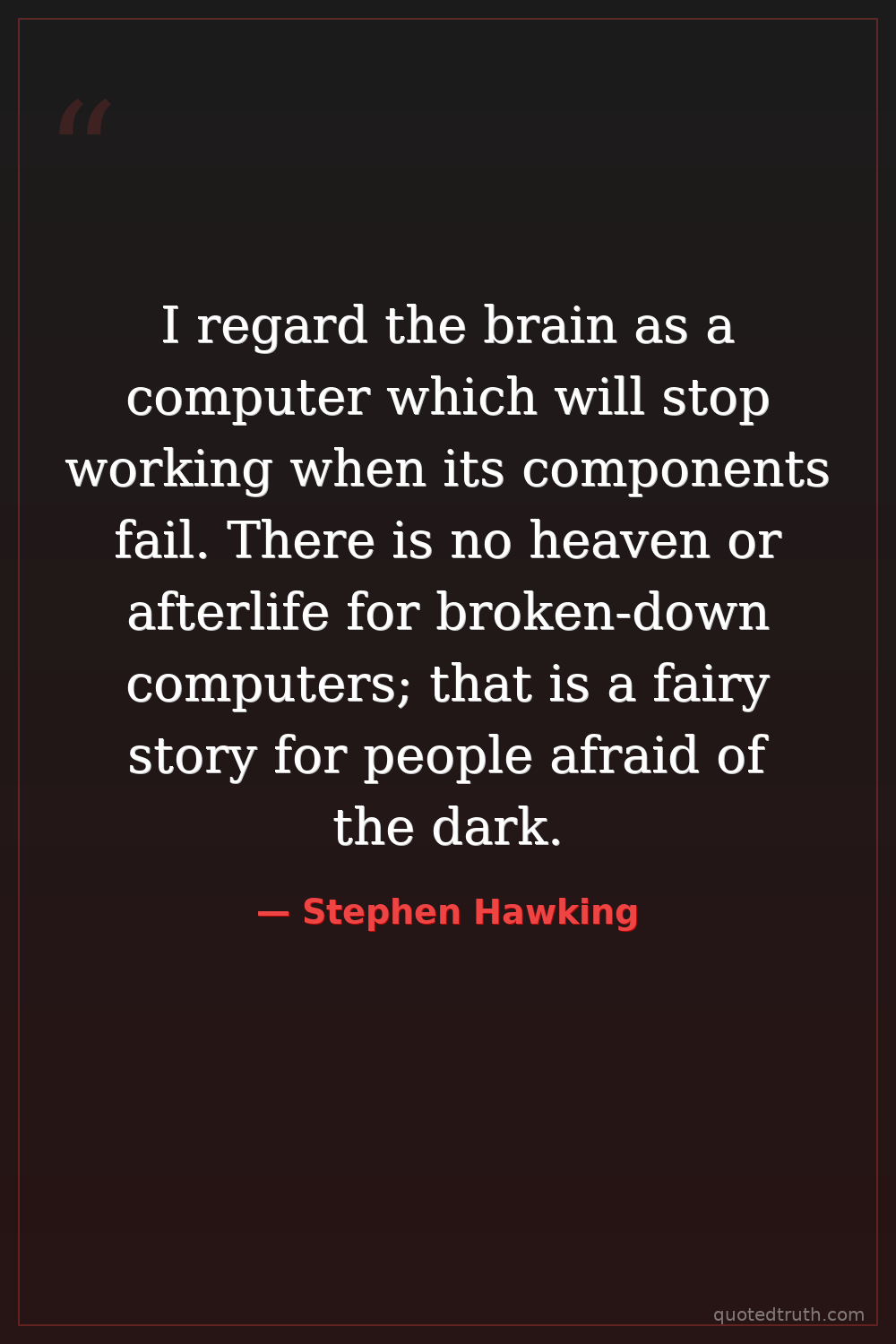
I regard the brain as a computer which will stop working when its components fail. There is no heaven or afterlife for broken-down computers; that is a fairy story for people afraid of the dark.
Stephen Hawking — Stephen Hawking Contemporary · Black holes, cosmology

Get This Quote & Author's Image Illustrated On:

Click any product to generate a realistic preview. Up to 3 at a time.
* Initial load can take up to 90 seconds — revising the preview in another color is nearly instant.

Kitchen

Apparel

Other

About Stephen Hawking (1942-2018)

British theoretical physicist whose Hawking radiation work and A Brief History of Time (1988) brought black-hole physics to a mass audience while he lived with ALS for 55 years. Closely associated with Roger Penrose (his collaborator on singularity theorems) and Carl Sagan (fellow popularizer who wrote Brief History's foreword). For an intellectual contrast, see William Lane Craig, American philosopher of religion — Craig's Kalam cosmological argument depends on the Big Bang requiring a divine first cause; Hawking's no-boundary proposal was specifically designed to remove the moment that would require one — the cleanest cosmology-vs-natural-theology contrast in modern thought.

Details

Interview with 'The Guardian'

Date: 2011

Religious

Verification

Unverifiable

Found in 1 providers: deepseek

1 source checked

Understanding this quote

What it means

The brain functions like a computer: when its physical parts break down, consciousness ends permanently. There is no soul that survives death, no spiritual realm waiting afterward. The idea of an afterlife is a comforting fiction invented to ease the fear of permanent nonexistence, not a rational conclusion supported by evidence.

Relevance to Stephen Hawking

Hawking lived with ALS for 55 years, facing his own mortality daily while his body progressively failed him. As a theoretical physicist committed to empirical reasoning, he applied the same materialist logic to human consciousness that he applied to black holes and cosmology. His computer metaphor reflects his lifelong view that the universe operates by discoverable physical laws, not supernatural ones.

The era

Hawking spoke these words in an era of rising scientific literacy but also persistent religious traditionalism. The late 20th and early 21st centuries saw growing public debate between secular humanism and religious frameworks for meaning. Neuroscience was advancing rapidly, mapping consciousness to brain states, giving scientific weight to materialist views of the mind that previous generations lacked.

AI-generated insights based on extensive research and information for context. Factual errors? Email [email protected].

Your Cart

Your cart is empty