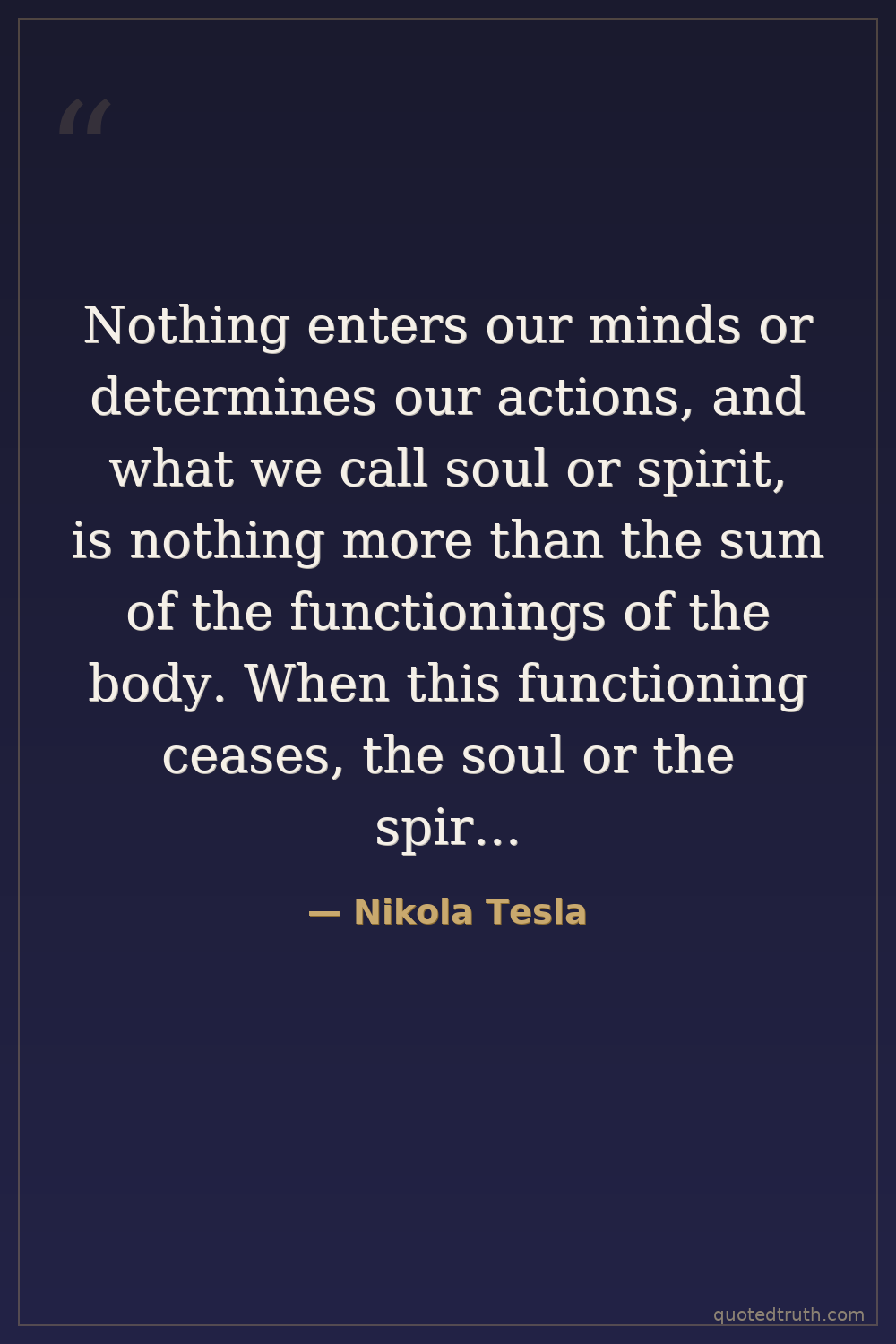
Nikola Tesla — "Nothing enters our minds or determines our actions, and what we call soul or spi…"

Nothing enters our minds or determines our actions, and what we call soul or spirit, is nothing more than the sum of the functionings of the body. When this functioning ceases, the soul or the spirit also ceases.
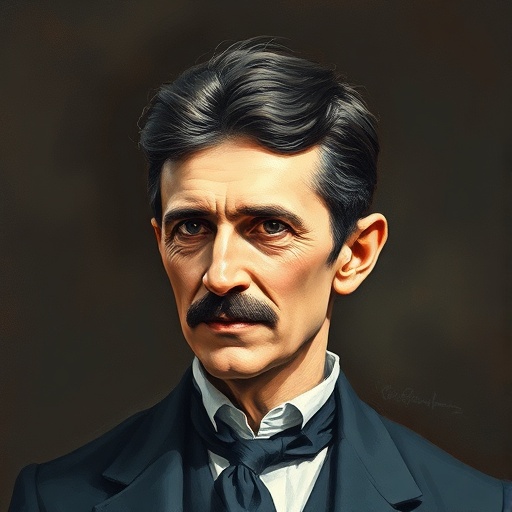
Nikola Tesla — Nikola Tesla Modern · AC electrical system, inventor

Get This Quote & Author's Image Illustrated On:

Click any product to generate a realistic preview. Up to 3 at a time.
* Initial load can take up to 90 seconds — revising the preview in another color is nearly instant.

Kitchen

Apparel

Other

About Nikola Tesla (1856-1943)

Serbian-American inventor and electrical engineer whose alternating-current designs powered the modern electrical grid; died poor and largely forgotten. Closely associated with George Westinghouse (his AC-power business partner) and Mihajlo Pupin (fellow Serbian-American physicist at Columbia). For an intellectual contrast, see Thomas Edison, American inventor and direct-current advocate — Edison's direct-current power-distribution scheme was displaced by Tesla-Westinghouse AC in the 1890s 'War of Currents'. Edison ran a public-relations campaign electrocuting animals to discredit AC — the most famous engineering-ethics rivalry in American history. Tesla's AC won and powers nearly every electrical grid on Earth.

Details

Deep, controversial, and mechanistic philosophical view on consciousness, soul, and spirit.

Date: Approximate

Philosophical

Verification

Unverifiable

Found in 1 providers: gemini

1 source checked

Understanding this quote

What it means

The mind, soul, and spirit are not separate supernatural entities but products of physical bodily processes. Consciousness emerges entirely from biological function—when the body stops working, so does everything we call the self. There is no immortal soul persisting after death. Identity and awareness are material phenomena, reducible to the mechanics of a living organism, nothing more mysterious than that.

Relevance to Nikola Tesla

Tesla was a fierce rationalist who trusted empirical science over religious doctrine. As an inventor who spent his life probing electromagnetic forces and measurable physical phenomena, he viewed reality through a strictly materialist lens. This mechanistic view of consciousness aligned with his engineering worldview: everything operates according to physical laws. Tesla rejected metaphysical explanations, grounding even questions about human consciousness in observable bodily function.

The era

Tesla lived through the late 19th and early 20th centuries, when scientific materialism challenged centuries of religious authority. Darwin's evolution, Helmholtz's work on energy conservation, and advancing neuroscience were dismantling vitalist theories that posited a separate life-force. Freud was mapping the mind mechanically. Industrialization and electrification suggested nature itself was a vast machine. Materialist philosophy was ascendant among intellectuals, making Tesla's view intellectually fashionable yet still culturally provocative.

AI-generated insights based on extensive research and information for context. Factual errors? Email [email protected].
Your Cart

Your cart is empty