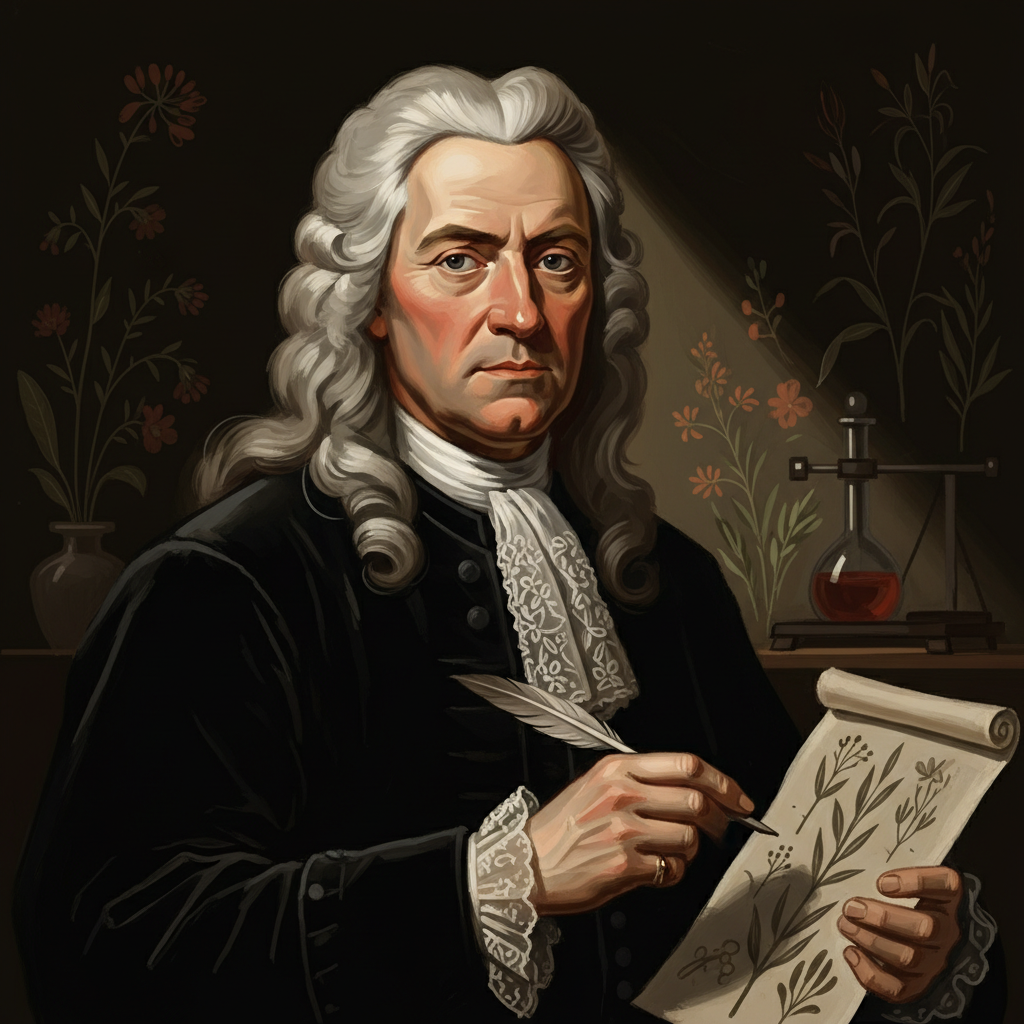
Carl Linnaeus — "Every flower is a soul blossoming in nature."
Every flower is a soul blossoming in nature.
Every flower is a soul blossoming in nature.
Click any product to generate a realistic preview. Up to 3 at a time.
* Initial load can take up to 90 seconds — revising the preview in another color is nearly instant.
"God's wisdom is as infinite as His power."
"The Earth's Creation is the glory of God, as seen from the works of Nature by Man alone."
"Blessed be the Lord for the beauty of summer and spring, for the air, the water, the verdure, and the song of birds."
"The more I study plants, the more I believe in God."
"Every country has its own plants, and every plant has its own country."
Swedish botanist and the father of modern taxonomy whose Systema Naturae (1735) introduced binomial nomenclature for naming all species. Closely associated with Joseph Banks (British naturalist who carried Linnaean classification on Cook's voyages). For an intellectual contrast, see Comte de Buffon, French naturalist and Histoire Naturelle author (1749-1788) — Buffon explicitly attacked Linnaean fixed-categories taxonomy as artificial and rejected the binomial system; his gradualist, environment-shaped natural history was the explicit alternative. Anticipates the fixed-species-vs-evolution debate Darwin would later resolve.
A poetic and anthropomorphic view of flowers, attributed.
Date: Uncertain (attributed)
BiblicalFound in 1 providers: gemini
1 source checked
Each flower carries its own vitality — a unique, irreducible expression of life. Just as a soul gives depth and individuality to a person, a flower embodies nature's capacity to produce something singular and alive. The natural world isn't mere mechanism; it pulses with distinct presences, each deserving recognition. Stop and look closely at any flower, and you encounter something genuinely irreplaceable.
Linnaeus spent his career cataloguing over 10,000 plant and animal species, naming each flower with systematic precision. Yet his Philosophia Botanica reveals a man who found personal meaning in plants beyond data. His sexual classification system — organized around stamens and pistils — treated flowers as differentiated, active beings. As a devout Lutheran, he believed each species was a unique divine creation, making close attention to flowers both scientific duty and spiritual practice.
Linnaeus worked (1707–1778) during the Enlightenment, when European naturalists were rationalizing and cataloguing the living world. Yet this era carried tension between Newtonian mechanism — nature as clockwork — and religious naturalism, which read divine intention into every species. Most naturalists, including Linnaeus, believed taxonomy revealed God's plan: each distinct flower was proof of purposeful creation, making the spiritual dimension of plants a mainstream 18th-century intellectual position.
AI-generated insights based on extensive research and information for context. Factual errors? Email [email protected].
Your cart is empty