Carl Linnaeus — "Every country has its own plants, and every plant has its own country."
Every country has its own plants, and every plant has its own country.
Every country has its own plants, and every plant has its own country.
Click any product to generate a realistic preview. Up to 3 at a time.
* Initial load can take up to 90 seconds — revising the preview in another color is nearly instant.
"The names of plants are the foundation of botany."
"God created, Linnaeus arranged. It is astonishing how many new species are discovered every day."
"The species are as numerous as the different forms which the Infinite Being produced in the beginning."
"The knowledge of plants is a science, but the knowledge of their names is a pleasure."
"By a botanist I mean one who understands how to observe the genera of Nature. I judge unworthy of the name of botanist the meddlesome person who is indifferent to genera."
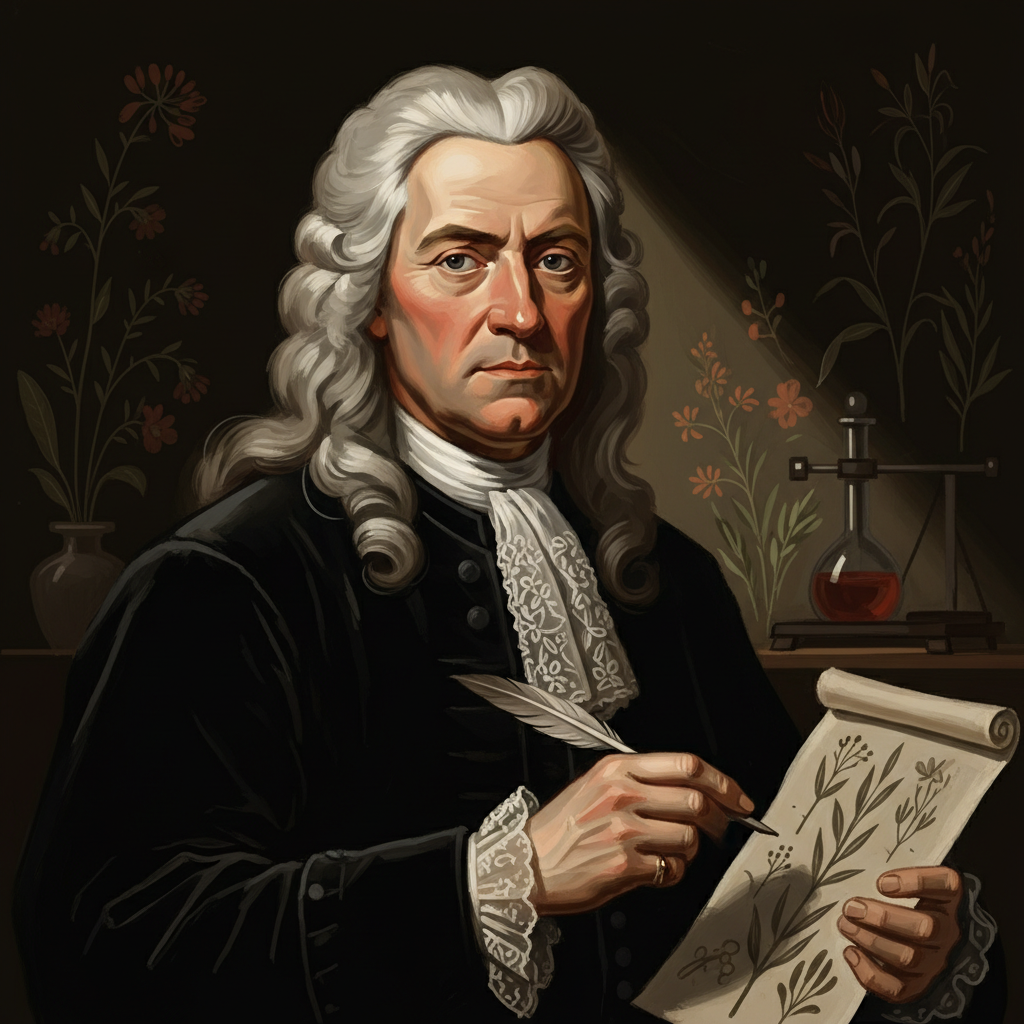
Swedish botanist and the father of modern taxonomy whose Systema Naturae (1735) introduced binomial nomenclature for naming all species. Closely associated with Joseph Banks (British naturalist who carried Linnaean classification on Cook's voyages). For an intellectual contrast, see Comte de Buffon, French naturalist and Histoire Naturelle author (1749-1788) — Buffon explicitly attacked Linnaean fixed-categories taxonomy as artificial and rejected the binomial system; his gradualist, environment-shaped natural history was the explicit alternative. Anticipates the fixed-species-vs-evolution debate Darwin would later resolve.
Found in 1 providers: gemini
1 source checked
Plants are not randomly scattered across the globe — each region harbors species uniquely suited to its climate, soil, and conditions, and each species belongs to a specific native range. Geography and biology are fundamentally inseparable. Knowing where a plant originates is as important as knowing its structure or name. This is the core of biogeography: place defines life, and life defines place.
Linnaeus dispatched student 'apostles' to every continent — Japan, Australia, South America, Africa — specifically to document regional flora. His Flora Suecica catalogued Sweden's native plants; his Species Plantarum systematized the world's. He believed nature followed rational geographic laws, and his binomial nomenclature encoded a plant's identity as distinct and bounded. The conviction that each plant belongs somewhere specific drove his entire taxonomic mission and the global specimen network he built.
The Age of Exploration had flooded European botanical gardens with exotic specimens from the Americas, Asia, and Africa. Colonial powers urgently needed to know which plants grew where — for medicine, trade, and agriculture. Linnaeus worked at the height of this frenzy, when distinguishing a plant's true native range from where it had been transplanted carried real economic stakes. Geographic origin was the difference between a rare commodity and a reproducible crop.
AI-generated insights based on extensive research and information for context. Factual errors? Email [email protected].
Your cart is empty