Werner Heisenberg — "Every word or concept, clear as it may seem to be, has only a limited range of a…"
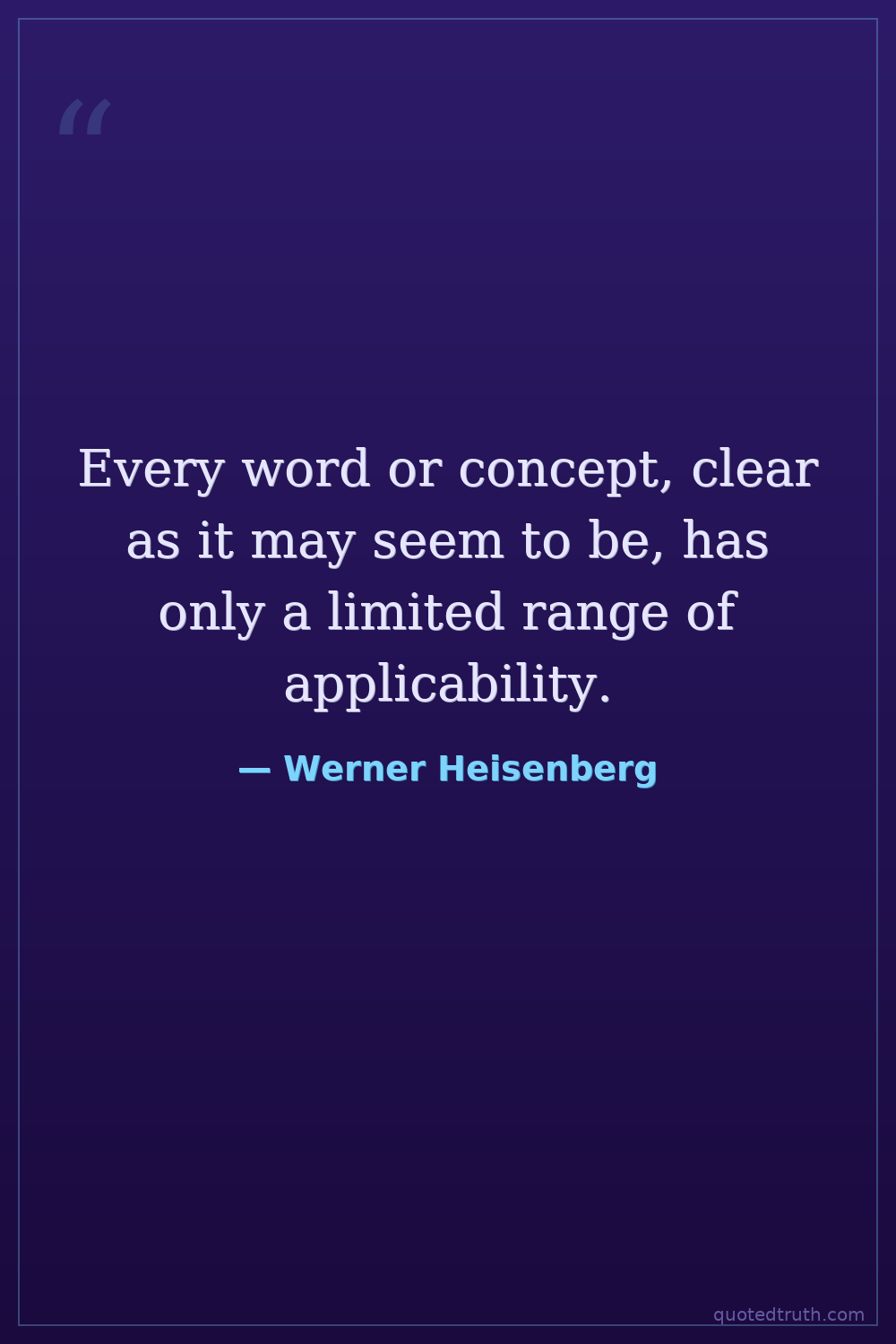
Every word or concept, clear as it may seem to be, has only a limited range of applicability.
Every word or concept, clear as it may seem to be, has only a limited range of applicability.
Click any product to generate a realistic preview. Up to 3 at a time.
* Initial load can take up to 90 seconds — revising the preview in another color is nearly instant.
"The more profound the knowledge, the more clear is the awareness of the limits of our knowledge."
"If a man is to be a good physicist, he must have an intuitive grasp of the physical reality, which can be acquired only by much experience."
"The concept of the objective reality of the elementary particles has thus evaporated not into the fog of some new, unclear, or not yet understood reality concept, but into the transparent clarity of a…"
"Our proposition that the physicists on both sides should not advance the production of atomic bombs, was thus indirectly, if one wants to exaggerate the point, a proposition in favor of Hitler."
"I don't believe a word of the whole thing they must have spent the whole of their £500. million in separating isotopes. and then it's possible."
On the inherent limitations of language and concepts
Date: 1955 (Physics and Philosophy)
WisdomFound in 2 providers: grok,deepseek
2 sources checked
Language and ideas work well within certain boundaries, but push them beyond those limits and they break down. Words that seem perfectly clear in everyday situations lose their precision when applied to unfamiliar territory. No concept is universally valid; each has a domain where it makes sense and a zone where it becomes misleading. Understanding the edges of our vocabulary matters as much as understanding the words themselves.
Heisenberg confronted this directly when building quantum mechanics. Classical words like position, velocity, and particle, which worked perfectly for planets and billiard balls, broke down at atomic scales. His uncertainty principle formalized the limits of such language. He spent decades arguing that ordinary concepts must be replaced or restricted when describing electrons, shaping his philosophical writings on physics and reality.
Heisenberg worked during the early twentieth century revolution in physics, when Einstein, Bohr, Schrodinger, and others dismantled Newtonian certainty. Debates raged about whether quantum reality could even be described in human language. Logical positivism and Wittgenstein were reshaping philosophy of language simultaneously. Scientists and thinkers grappled with atomic theory, relativity, and eventually nuclear weapons, forcing a cultural reckoning with the limits of intuition, vocabulary, and classical worldviews.
AI-generated insights based on extensive research and information for context. Factual errors? Email [email protected].
Your cart is empty