What it means
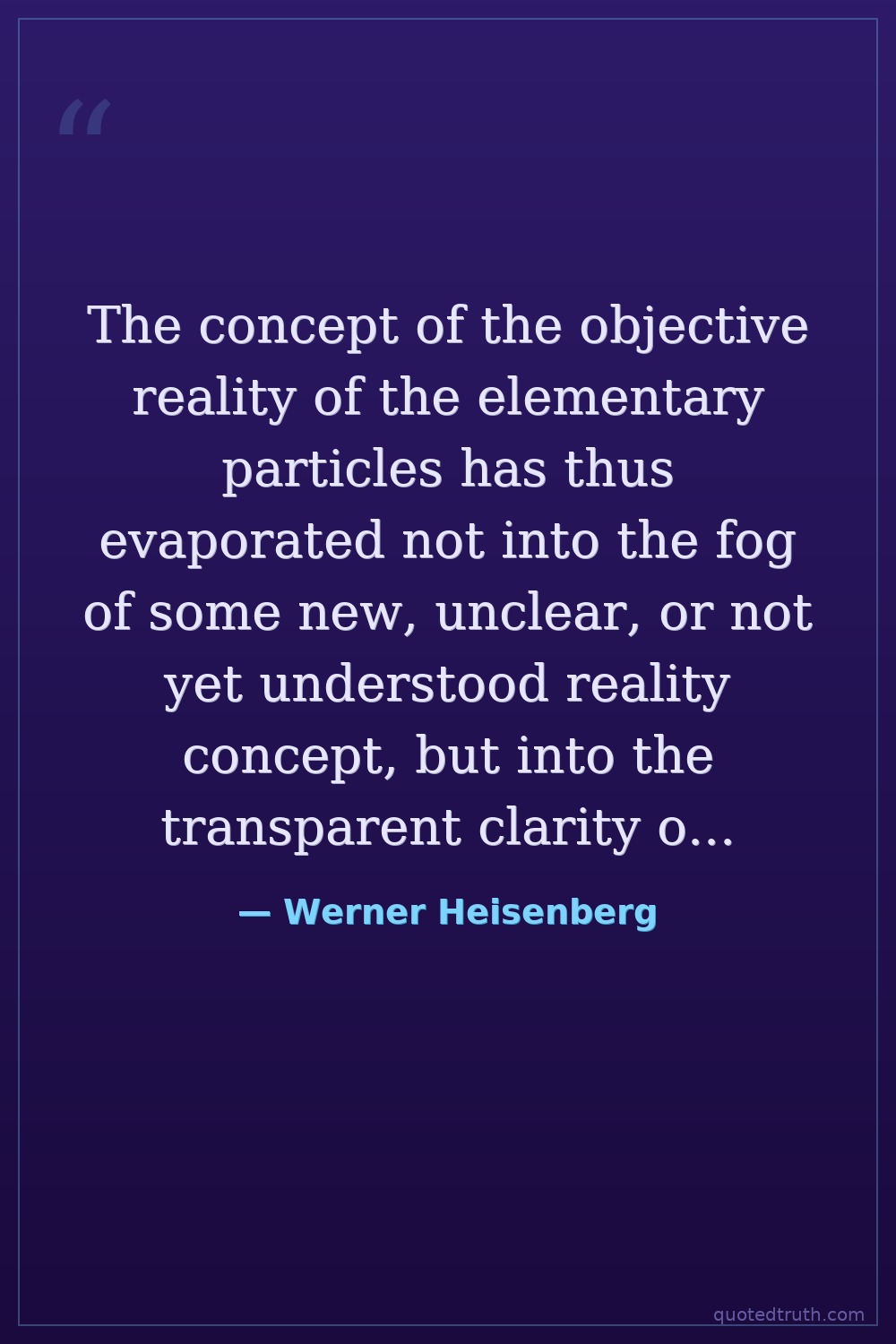
Tiny particles like electrons don't have fixed, observable properties existing independently of us. When we try to pin down their reality, what remains isn't mysterious fog but crisp mathematical equations. Those equations don't describe the particles themselves acting in definite ways. Instead, they describe what we can know about them, our information and predictions. Reality at the smallest scale becomes a map of our knowledge rather than a picture of things behaving objectively on their own.
Relevance to Werner Heisenberg
Heisenberg pioneered quantum mechanics and formulated the 1927 uncertainty principle, proving you cannot simultaneously know a particle's position and momentum precisely. He championed matrix mechanics, using pure math over visualizable models. As a leader of the Copenhagen interpretation alongside Bohr, he argued physics describes observations, not an observer-independent world. This quote captures his lifelong conviction that quantum theory dissolved classical objectivity, replacing it with mathematical structures encoding measurement outcomes, a view he defended against Einstein's realism throughout his career.
The era
Heisenberg worked through the 1920s quantum revolution, when atomic experiments shattered Newtonian certainty and forced physicists to rethink reality itself. Einstein's relativity had already bent space and time; now Bohr, Schrodinger, Born, and Heisenberg were debating whether particles even had definite properties before measurement. Writing amid World War II and the postwar philosophical upheaval, Heisenberg watched classical determinism collapse alongside European political order. Science, philosophy, and culture were all grappling with whether objective truth survived, making his interpretation deeply resonant with the century's broader crisis of certainty.
AI-generated insights based on extensive research and information for context. Factual errors? Email [email protected].