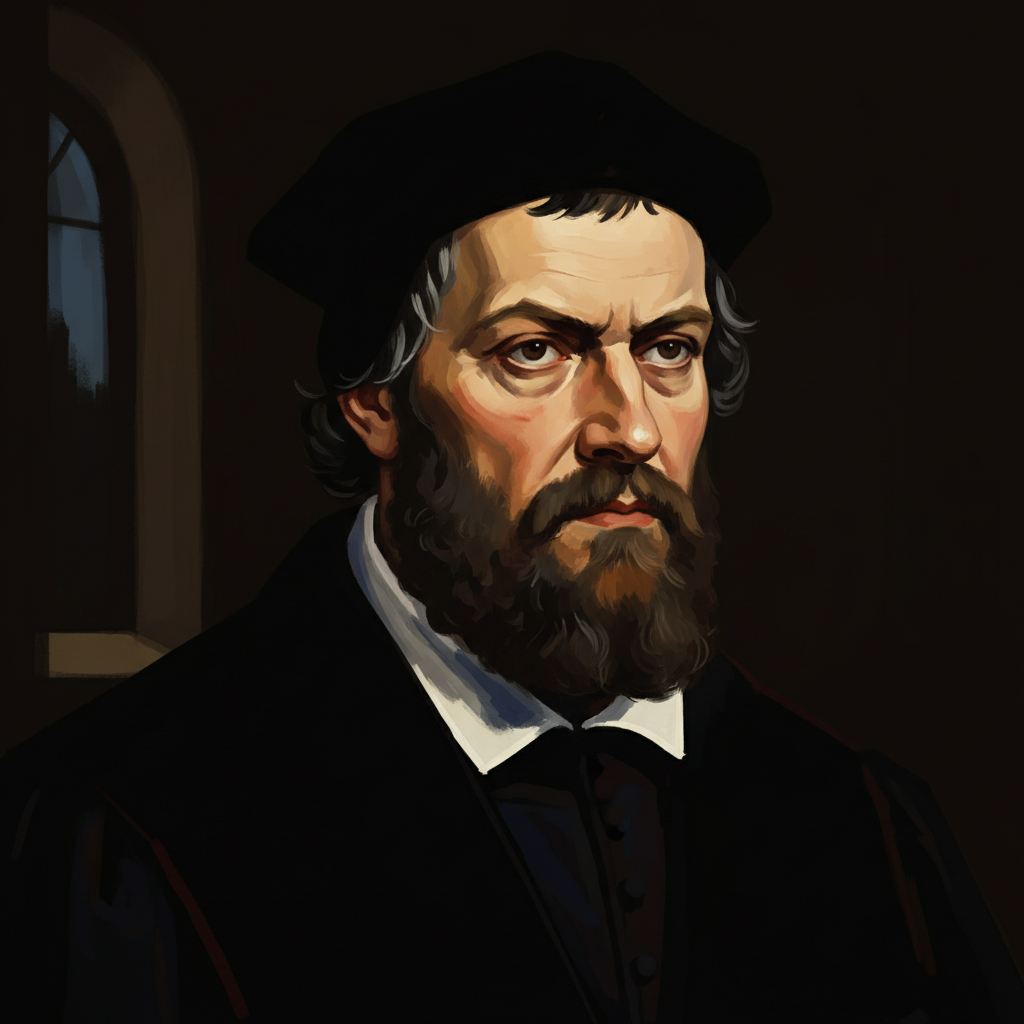
Martin Luther — "Faith is permitting ourselves to be seized by the things we do not see."
Faith is permitting ourselves to be seized by the things we do not see.
Faith is permitting ourselves to be seized by the things we do not see.
Click any product to generate a realistic preview. Up to 3 at a time.
* Initial load can take up to 90 seconds — revising the preview in another color is nearly instant.
"The Christian's life is not a bed of roses, but a cross."
"A woman is a human being with a womb."
"A Christian is a perfectly free lord of all, subject to none. A Christian is a perfectly dutiful servant of all, subject to all."
"Let us therefore be rid of the Mass and all that pertains to it, and let us use the holy Supper of Christ in its simplicity."
"I have so much to do today that I shall spend the first three hours in prayer."
German theologian whose 95 Theses (1517) launched the Protestant Reformation and broke the Catholic Church's monopoly on Western Christianity. Closely associated with Philipp Melanchthon (Lutheran systematizer) and John Calvin (later Reformer who built on Luther's break). For an intellectual contrast, see Pope Leo X, Renaissance pope (1513-1521) — Leo X's indulgence sales triggered Luther's break and Leo excommunicated him in 1521 — Luther's entire Reformation is structured as a direct answer to the indulgence-funded Vatican Leo represented.
Found in 1 providers: gemini
1 source checked
Faith isn't a logical conclusion you reach by examining evidence. Instead, it's an act of surrender, where you allow invisible realities to grab hold of you and shape how you live. You're not the one doing the grasping; something beyond your senses does the grasping. Trust here is passive and receptive rather than calculated, requiring you to loosen your grip on needing proof before committing yourself fully to what cannot be verified.
Luther built his entire theology on sola fide, the idea that faith alone justifies a person before God, not works or church sacraments. After his tower experience studying Romans, he rejected earning salvation through visible rituals like indulgences. This definition captures his insistence that faith is a gift received, not a human achievement, aligning with his view that God seizes sinners rather than sinners climbing toward God through effort.
In early sixteenth-century Europe, the Catholic Church dominated religious life through visible, tangible practices: relics, indulgence certificates, pilgrimages, and priestly mediation. Luther's 1517 Ninety-Five Theses challenged this visible apparatus of salvation, sparking the Reformation. Amid printing-press-fueled debates, peasant revolts, and political fractures across the Holy Roman Empire, redefining faith as invisible trust rather than purchased merit was revolutionary, undermining ecclesiastical authority and reshaping how millions understood their relationship with the divine.
AI-generated insights based on extensive research and information for context. Factual errors? Email [email protected].
Your cart is empty