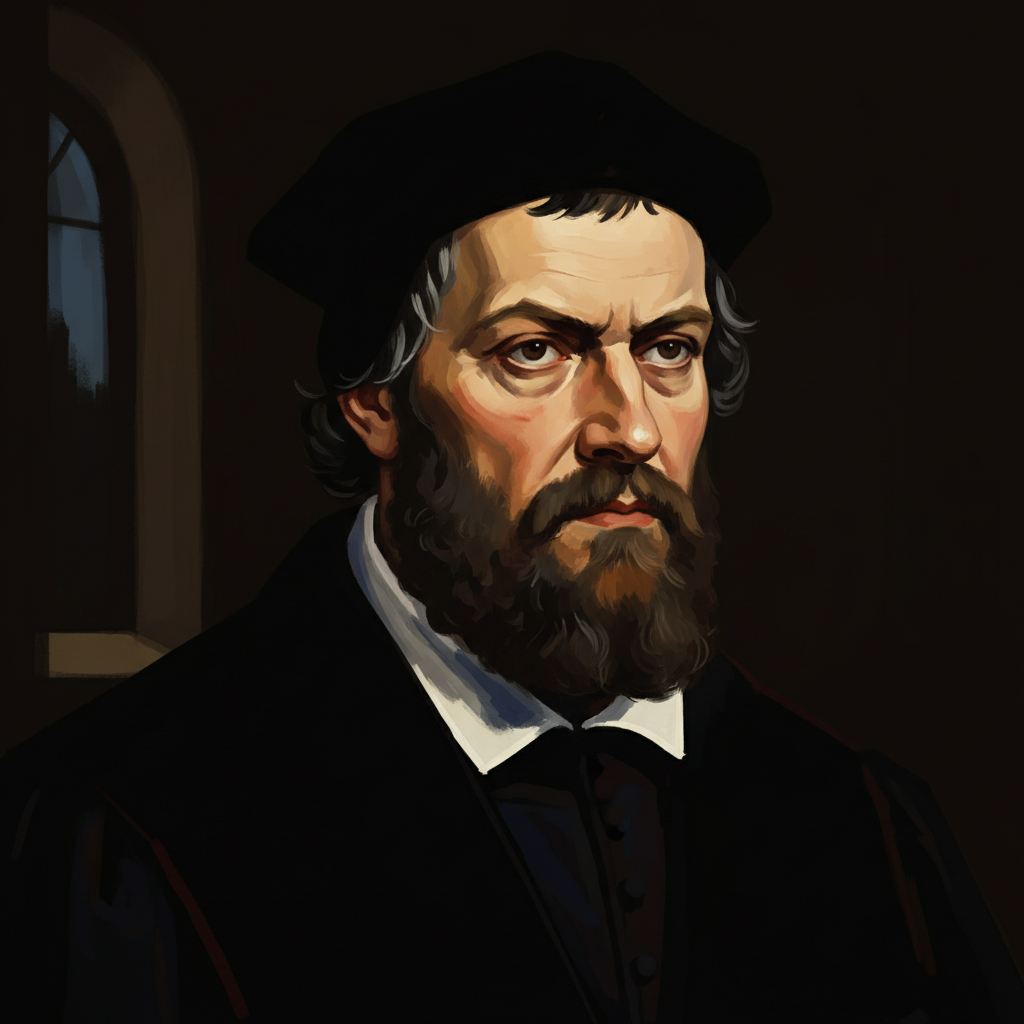
Martin Luther — "I have so much to do today that I shall spend the first three hours in prayer."
I have so much to do today that I shall spend the first three hours in prayer.
I have so much to do today that I shall spend the first three hours in prayer.
Click any product to generate a realistic preview. Up to 3 at a time.
* Initial load can take up to 90 seconds — revising the preview in another color is nearly instant.
"You are not yet a master of the Scriptures. You will find that out when you try to preach."
"The ass needs to be beaten, and the populace needs to be ruled by force. God knew this well, and therefore he gave the ruler not a fox's tail, but a sword."
"The greatest blessing of all is to have a wife who is pious, God-fearing, and domestic."
"God hides in order not to be found where humans want to find God. But God also hides in order to be found where God wills to be found."
"What God wills is not right because he ought, or was bound, so to will; on the contrary, what takes place must be right, because he so wills it."
German theologian whose 95 Theses (1517) launched the Protestant Reformation and broke the Catholic Church's monopoly on Western Christianity. Closely associated with Philipp Melanchthon (Lutheran systematizer) and John Calvin (later Reformer who built on Luther's break). For an intellectual contrast, see Pope Leo X, Renaissance pope (1513-1521) — Leo X's indulgence sales triggered Luther's break and Leo excommunicated him in 1521 — Luther's entire Reformation is structured as a direct answer to the indulgence-funded Vatican Leo represented.
A common saying attributed to him, emphasizing the importance of prayer.
Date: 1520s-1530s
BiblicalFound in 2 providers: grok,gemini
2 sources checked
When facing a demanding schedule, the speaker responds counterintuitively by dedicating extra time to prayer rather than cutting it to save minutes. The heavier the workload, the more preparation and grounding is needed, not less. Instead of treating spiritual focus as optional when busy, it becomes the foundation that makes a packed day manageable. Busyness is precisely the reason to slow down first, because rushing without centering leads to worse outcomes.
Luther juggled translating the Bible into German, writing theological treatises, lecturing at Wittenberg, corresponding with reformers across Europe, and defending himself against papal and imperial authorities. His workload was genuinely crushing. As an Augustinian monk turned reformer, he insisted that ordinary believers could approach God directly without priestly mediation, and his own discipline of prayer reflected the piety he preached. The quote embodies his conviction that faith fuels action rather than competing with it.
In the early sixteenth century, the Reformation was fracturing Western Christianity after Luther's 1517 Ninety-Five Theses challenged indulgences and papal authority. Printing presses spread his tracts faster than Rome could respond, triggering religious wars, peasant revolts, and the rise of territorial Protestant churches. Daily monastic prayer hours were the cultural norm for clergy, but Luther was reshaping piety around personal scripture reading and direct prayer, making a reformer's devotional discipline both a personal habit and a public theological statement.
AI-generated insights based on extensive research and information for context. Factual errors? Email [email protected].
Your cart is empty