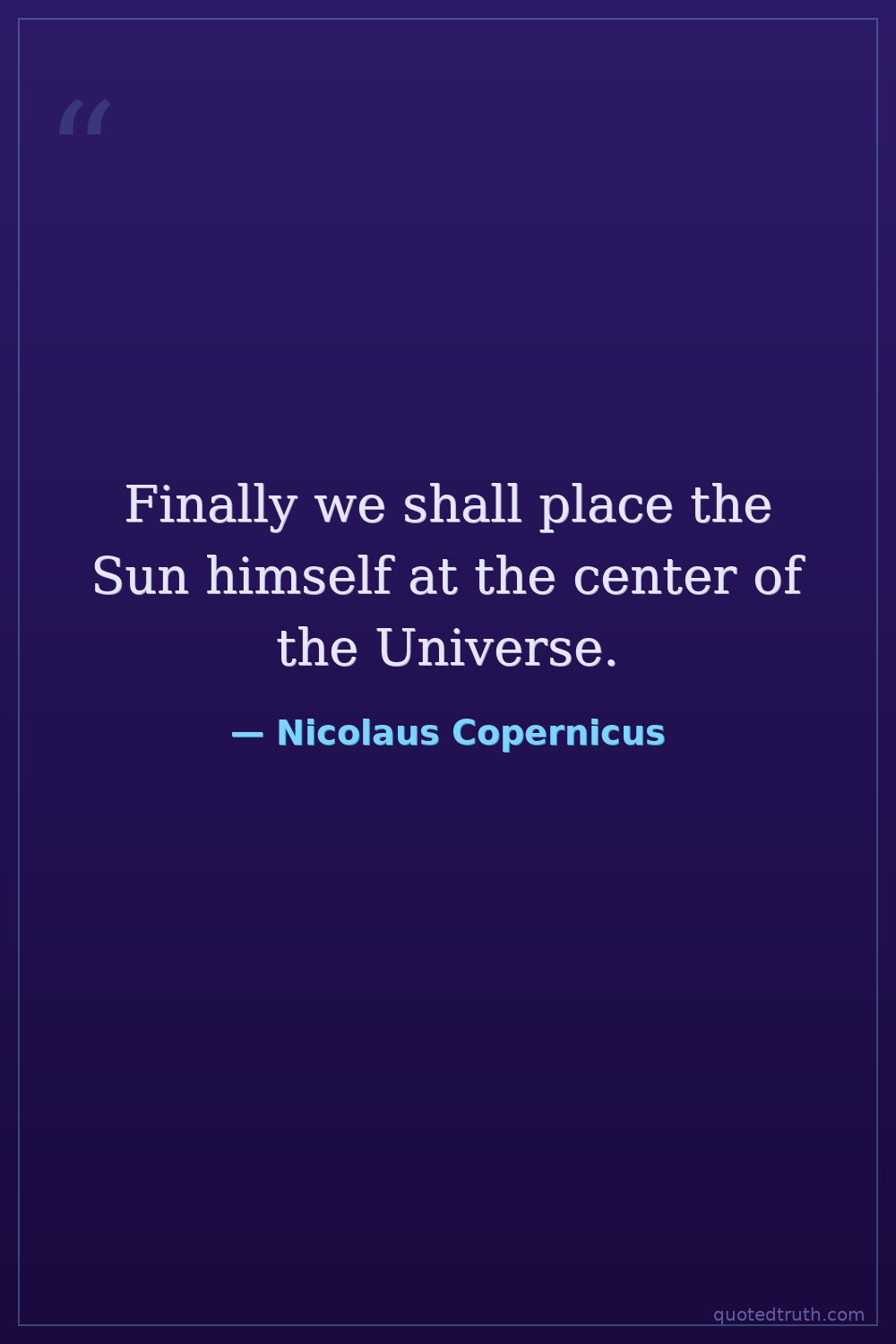
Nicolaus Copernicus — "Finally we shall place the Sun himself at the center of the Universe."
Finally we shall place the Sun himself at the center of the Universe.
Finally we shall place the Sun himself at the center of the Universe.
Click any product to generate a realistic preview. Up to 3 at a time.
* Initial load can take up to 90 seconds — revising the preview in another color is nearly instant.
"We are thus brought to a standstill by the realization that our previous theories were not only complicated but also inconsistent."
"It is enough if the hypotheses save the phenomena."
"For the motion of the earth is not a simple motion, but a composite of many motions."
"I have been so long in preparing this work that I have almost despaired of publishing it."
"For the motion of the earth is a fact, and the apparent change of position of the fixed stars is due to the earth's motion and not to any motion of the stars themselves."
From 'De Revolutionibus Orbium Coelestium' (On the Revolutions of the Heavenly Spheres)
Date: 1543
Nature & WorldFound in 1 providers: deepseek
1 source checked
The Sun, not Earth, sits at the center of everything — all planets, including our own, orbit around it. The word 'finally' signals a break from centuries of assumption: humanity has looked carefully enough at the evidence to correct itself. It is a declaration that truth, however uncomfortable, must replace tradition when observation demands it.
Copernicus was a Polish church canon who spent decades in quiet, meticulous calculation before publishing De Revolutionibus Orbium Coelestium in 1543, the very year he died. He delayed publication for years fearing ridicule. That single word 'finally' reflects his patient, cautious temperament — a man who waited until his mathematics were unassailable before making a claim that upended fourteen centuries of received wisdom.
Ptolemy's geocentric model had been astronomical orthodoxy for over 1,400 years, reinforced by Church doctrine that placed humanity — and therefore Earth — at creation's center. The early modern period was straining against medieval certainty: the printing press was spreading ideas, Renaissance humanism encouraged direct inquiry, and calendar reform urgently needed accurate planetary tables. Copernicus published into this tension, where a single cosmological claim carried theological, political, and scientific consequences simultaneously.
AI-generated insights based on extensive research and information for context. Factual errors? Email [email protected].
Your cart is empty