Nicolaus Copernicus — "We are thus brought to a standstill by the realization that our previous theorie…"
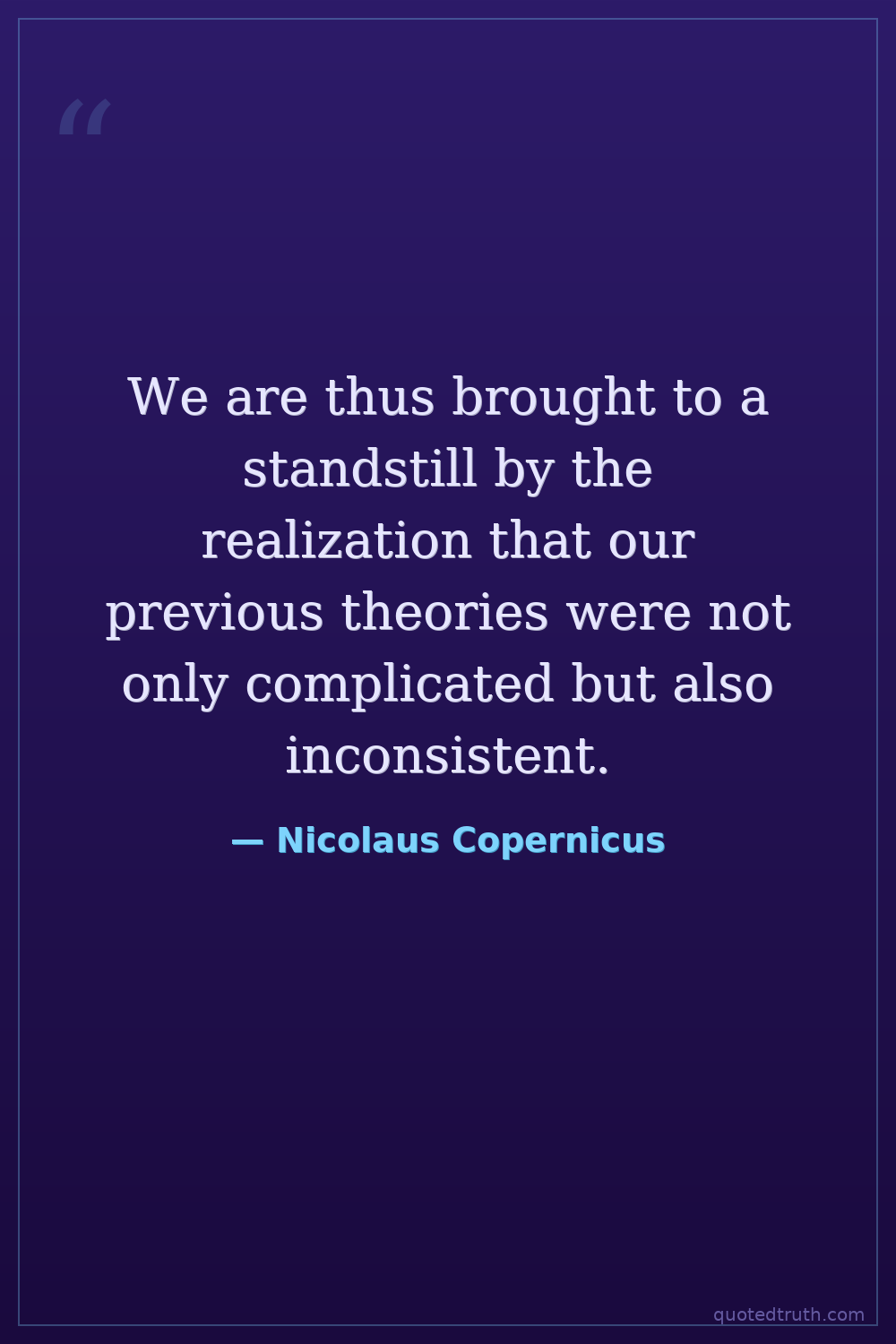
We are thus brought to a standstill by the realization that our previous theories were not only complicated but also inconsistent.
We are thus brought to a standstill by the realization that our previous theories were not only complicated but also inconsistent.
Click any product to generate a realistic preview. Up to 3 at a time.
* Initial load can take up to 90 seconds — revising the preview in another color is nearly instant.
"For among these, the first and chief consideration is the size of the sphere of the fixed stars, which is immense, and the next is the size of the earth, which is as a point in comparison with the hea…"
"I am aware that I have made myself liable to be laughed at by those who consider it an absurdity to suppose that the earth moves."
"It is enough if the hypotheses save the phenomena."
"Perhaps there will be babblers who, although completely ignorant of mathematics, nevertheless dare to pass judgment on these things and, on the strength of some passage in Scripture, twisted to their …"
"For the motions of the planets are so much more orderly and harmonious if they are referred to the sun as the center."
De revolutionibus orbium coelestium (paraphrased sentiment regarding Ptolemaic system)
Date: 1543
WisdomFound in 1 providers: grok
1 source checked
Sometimes progress demands stopping cold to admit that inherited explanations are not merely unwieldy but fundamentally contradictory at their core. When a framework requires endless patches to explain observed reality, its complexity is a symptom of deeper failure. The honest response is not refinement but replacement — the uncomfortable moment before a paradigm shift, recognizing that the old map doesn't just need updating but was drawn from the wrong starting point entirely.
Copernicus spent decades dissecting Ptolemaic astronomy — a geocentric system propped up by epicycles, equants, and deferents accumulated across fourteen centuries. He found it not just cumbersome but logically incoherent: the equant device violated Aristotle's own uniform-motion principle, yet the system invoked both simultaneously. His De Revolutionibus (1543) replaced it with heliocentrism not for elegance alone but because consistency demanded a new center. He circulated early drafts for decades, fully aware of the stakes.
In early modern Europe, Ptolemaic cosmology had been doctrine for over 1,400 years, enmeshed with Church theology and Aristotelian philosophy. Yet Renaissance scholars recovering Greek texts discovered cracks, including awareness of Aristarchus's ancient heliocentric proposal. Practical pressures mounted too: calendar reform exposed the model's predictive failures. Astronomers kept adding epicycles as workarounds, but the architecture was visibly straining. Copernicus lived at the precise moment when accumulated complexity made the system's internal contradictions impossible to ignore.
AI-generated insights based on extensive research and information for context. Factual errors? Email [email protected].
Your cart is empty