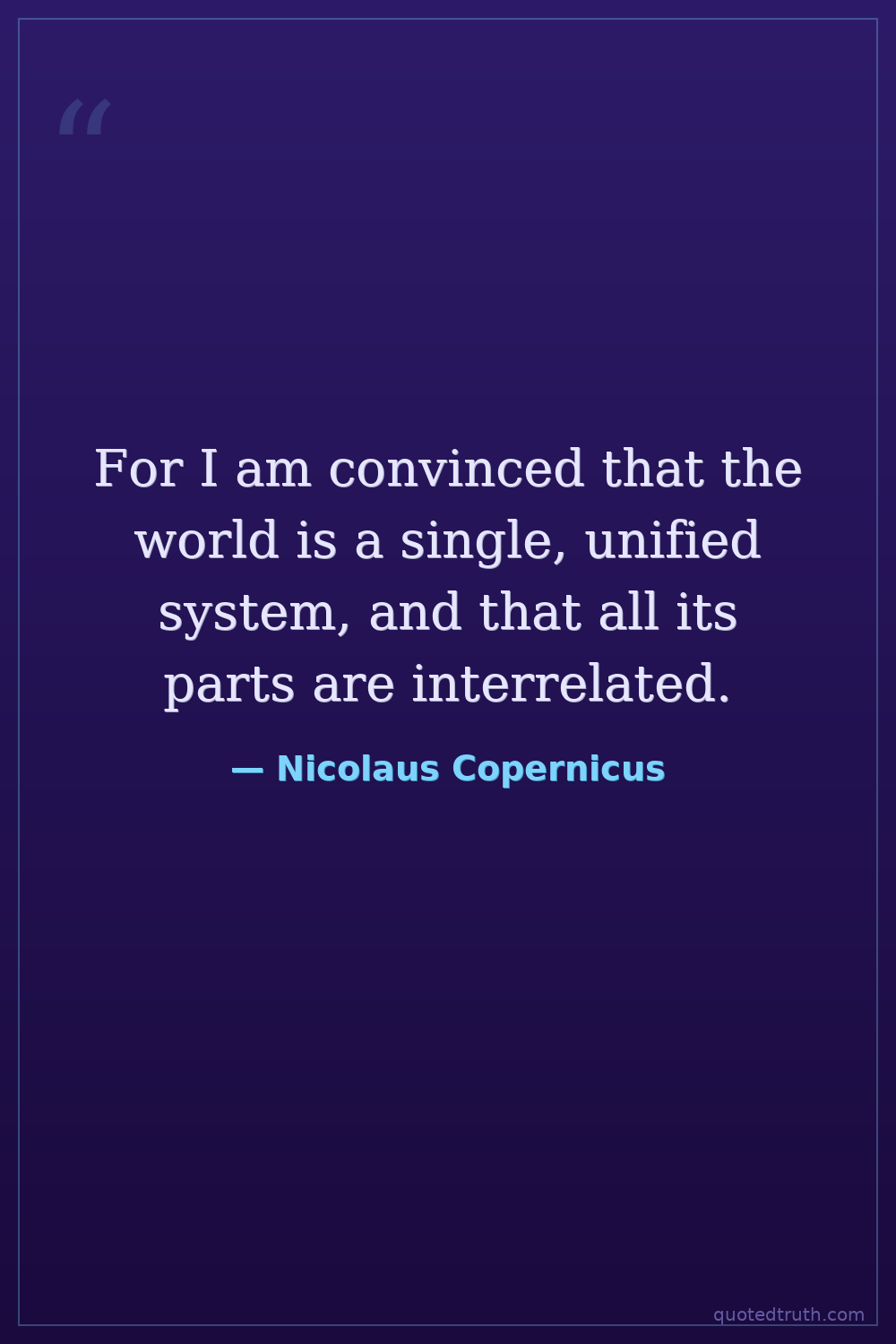
Nicolaus Copernicus — "For I am convinced that the world is a single, unified system, and that all its …"
For I am convinced that the world is a single, unified system, and that all its parts are interrelated.
For I am convinced that the world is a single, unified system, and that all its parts are interrelated.
Click any product to generate a realistic preview. Up to 3 at a time.
* Initial load can take up to 90 seconds — revising the preview in another color is nearly instant.
"For among these, the first and chief consideration is the size of the sphere of the fixed stars, which is immense, and the next is the size of the earth, which is as a point in comparison with the hea…"
"And if the earth were to stand still, the appearance of the heavens would be very different."
"It is not the earth that is the center of the universe, but the sun."
"The Sun, the Moon, and the Earth, are all parts of one great system."
"The sphere is the most perfect of all figures, hence it is the form of the world."
Attributed, general sentiment but not a direct quote from his major work.
Date: 16th Century (approx.)
WisdomFound in 1 providers: grok
1 source checked
The universe operates as one coherent, interconnected whole rather than a collection of separate, unrelated phenomena. Every part influences and relates to every other part. Understanding any piece requires understanding how it fits within the larger system. This reflects a fundamentally holistic worldview — reality has underlying unity, and apparent chaos or complexity resolves into elegant order when examined with sufficient rigor and open-minded inquiry.
Copernicus spent decades building his heliocentric model precisely because he believed celestial motions must form a mathematically harmonious system. He rejected the patchwork Ptolemaic epicycles as inelegant and unconvincing. His *De Revolutionibus* (1543) reorganized planetary orbits around the Sun specifically because this arrangement made the cosmos geometrically consistent — planets' speeds and distances finally made unified sense, vindicating his belief in systemic coherence over ad hoc corrections.
Renaissance Europe was dissolving medieval compartmentalized thinking — theology, natural philosophy, and mathematics were being reunified under humanist scholarship. Scholars rediscovered ancient Greek texts emphasizing cosmic harmony and mathematical order. The printing press spread systematic knowledge across borders. Copernicus worked during this intellectual ferment, when challenging Aristotelian astronomy was dangerous but increasingly thinkable, and when synthesizing disparate observations into unified explanatory frameworks was the era's highest intellectual ambition.
AI-generated insights based on extensive research and information for context. Factual errors? Email [email protected].
Your cart is empty