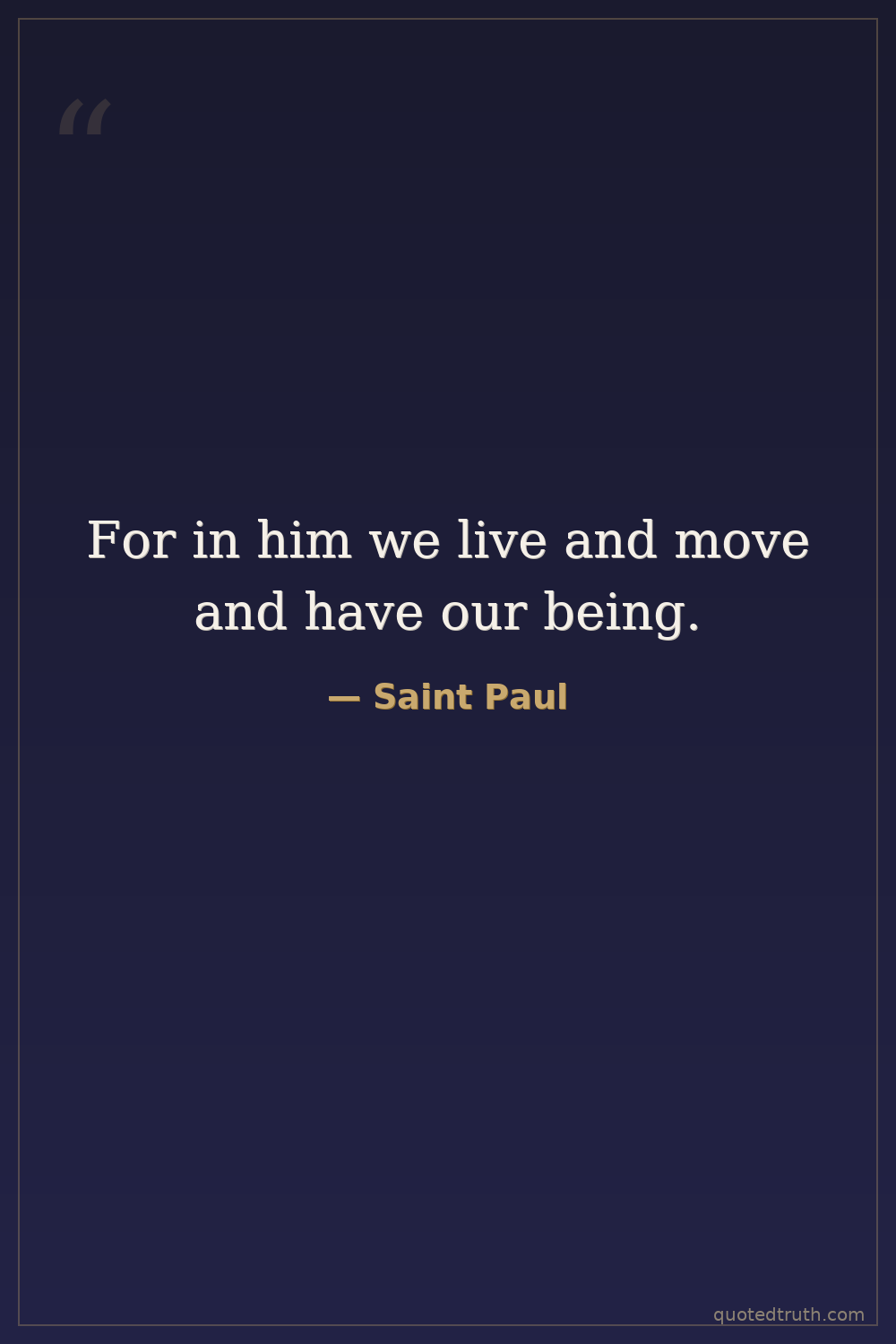
Saint Paul — "For in him we live and move and have our being."
For in him we live and move and have our being.
For in him we live and move and have our being.
Click any product to generate a realistic preview. Up to 3 at a time.
* Initial load can take up to 90 seconds — revising the preview in another color is nearly instant.
"For ye suffer fools gladly, seeing ye yourselves are wise."
"But I would have you know, that the head of every man is Christ; and the head of the woman is the man; and the head of Christ is God."
"For the message of the cross is foolishness to those who are perishing, but to us who are being saved it is the power of God."
"For if the trumpet gives an uncertain sound, who will prepare for battle?"
"Not all of those who descend from Israel are Israel."
Found in 1 providers: gemini
1 source checked
Everything about human existence depends on God. Our breath, our movement, our awareness, even our capacity to think this thought, all happen inside a reality God sustains moment by moment. We are not self-contained beings who occasionally interact with the divine. We are continuously held in existence by something larger, the way a fish is held by water it never leaves and rarely notices.
Paul said this in Athens, quoting a Greek poet to philosophers who worshipped many gods. As a former Pharisee turned missionary to non-Jews, he made his career translating Hebrew monotheism into language Greeks and Romans could grasp. This line shows his signature move: meeting outsiders on their own intellectual turf, borrowing their poets, then redirecting the idea toward the single God he believed had revealed himself in Jesus.
First-century Athens was a crowded religious marketplace with altars to dozens of gods, including one inscribed 'to an unknown god.' Stoic and Epicurean philosophers debated divine nature publicly. Paul spoke at the Areopagus around 50 CE, where new ideas were formally vetted. Quoting the Cretan poet Epimenides let him claim common ground while challenging the polytheism, statue-worship, and civic religion that structured nearly every aspect of Greek and Roman daily life.
AI-generated insights based on extensive research and information for context. Factual errors? Email [email protected].
Your cart is empty