What it means
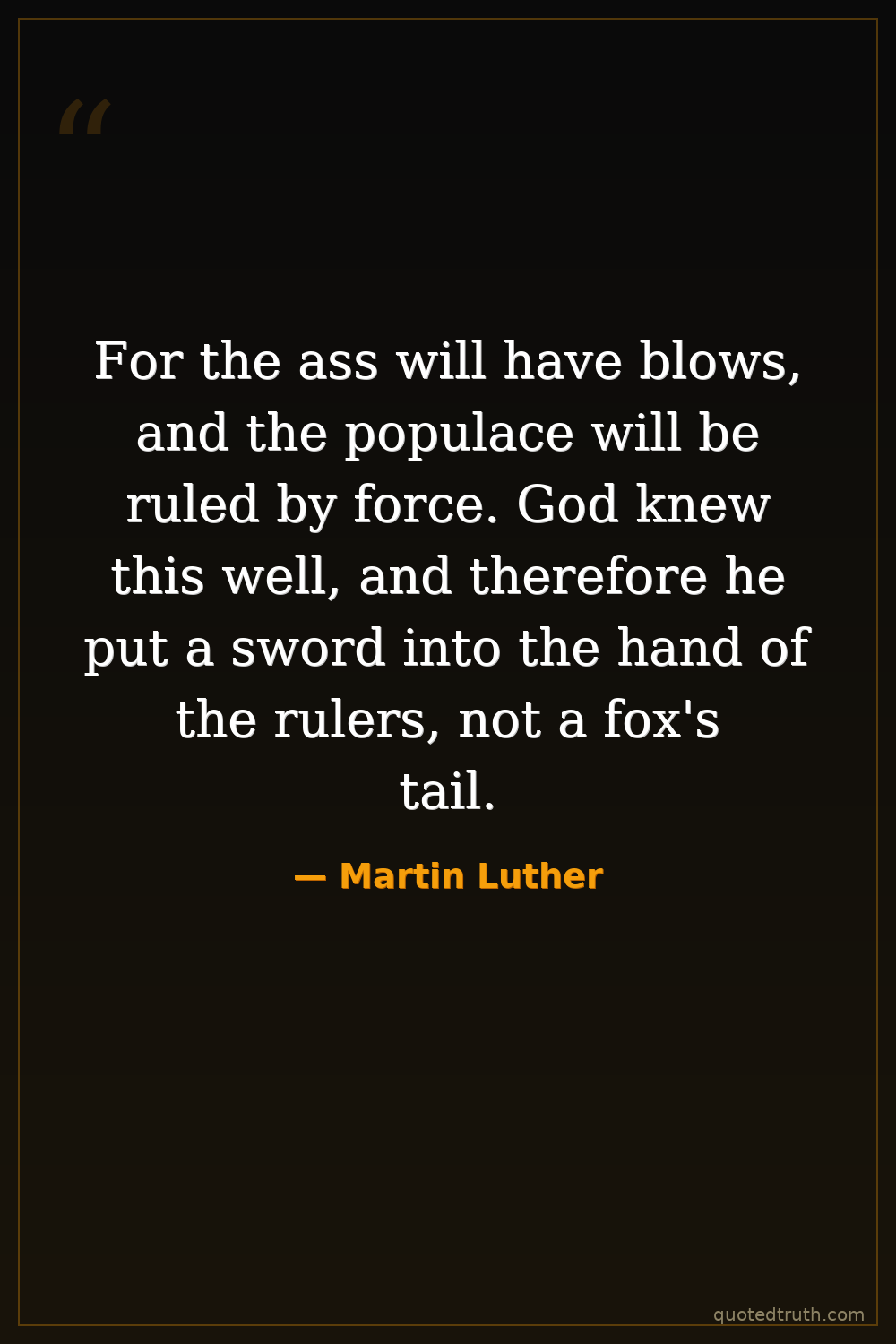
Luther argues that ordinary people respond only to coercion, not gentle persuasion. Just as a stubborn donkey needs beating to move, the masses must be governed through raw force rather than clever manipulation. He claims God understood human nature perfectly, which is why divine authority armed rulers with genuine weapons of punishment instead of mere trickery. Authority requires actual power to compel obedience, not cunning alone.
Relevance to Martin Luther
Luther sharply separated spiritual and temporal realms in his Two Kingdoms doctrine, insisting secular rulers wield the sword as God's appointed instrument. After the 1525 Peasants' War, he famously urged princes to slaughter rebelling peasants, viewing harsh civil force as divinely ordained. This quote reflects his hardened stance that earthly government exists precisely to restrain sinful humanity through punishment, not persuasion, matching his increasingly authoritarian political theology.
The era
The early sixteenth century witnessed massive social upheaval as the Reformation shattered medieval religious unity. Peasant revolts erupted across German lands in 1524-1525, with commoners citing Luther's own teachings to justify overthrowing lords. Princes demanded theological justification for crushing rebellions. Meanwhile, the Holy Roman Empire fragmented along confessional lines, and questions about legitimate authority, obedience, and the limits of resistance dominated public discourse amid executions, wars, and political instability.
AI-generated insights based on extensive research and information for context. Factual errors? Email [email protected].