What it means
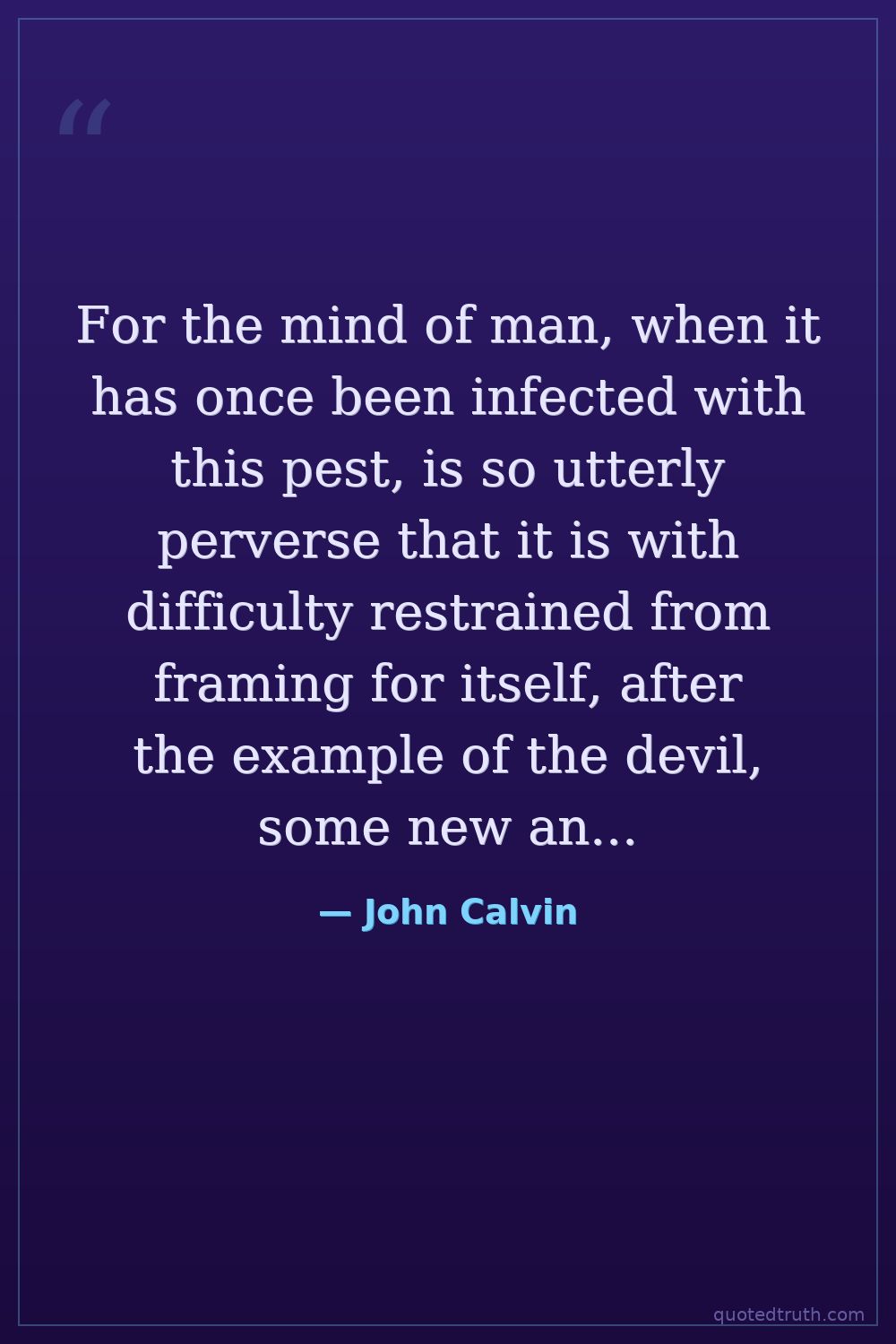
Once the human mind becomes corrupted by error — Calvin's 'pest,' likely idolatry or false doctrine — it becomes nearly impossible to stop it from inventing new, unauthorized forms of worship. In plain terms: humans are wired to create religion, and without a fixed authoritative standard, that impulse spirals into self-serving spiritual innovations. Calvin sees this not as natural curiosity but as a satanic tendency, the fallen mind mimicking the devil's own rebellion against God.
Relevance to John Calvin
Calvin spent his career in Geneva enforcing worship practices grounded solely in Scripture — the regulative principle — rejecting Catholic traditions he considered man-made inventions. He battled Anabaptists, Libertines, and Servetus over unauthorized theological innovations. His Institutes of the Christian Religion systematically diagnosed humanity's tendency to corrupt pure religion. This quote distills his core conviction: human depravity makes religious self-invention inevitable without Scripture's restraint, justifying Geneva's notoriously rigorous theological discipline and church governance.
The era
The 16th-century Reformation shattered Western Christianity's unity. Catholic practices — saint veneration, indulgences, elaborate liturgies — had accumulated for centuries, and Reformers declared them human inventions displacing God's word. Simultaneously, radical sects like Anabaptists proliferated new doctrines seemingly daily. Calvin wrote amid this explosion of competing religious claims. His warning about self-invented worship addressed both Catholic accretion and Protestant fragmentation, positioning Scripture as the only reliable anchor against human religious creativity run spiritually amok.
AI-generated insights based on extensive research and information for context. Factual errors? Email [email protected].