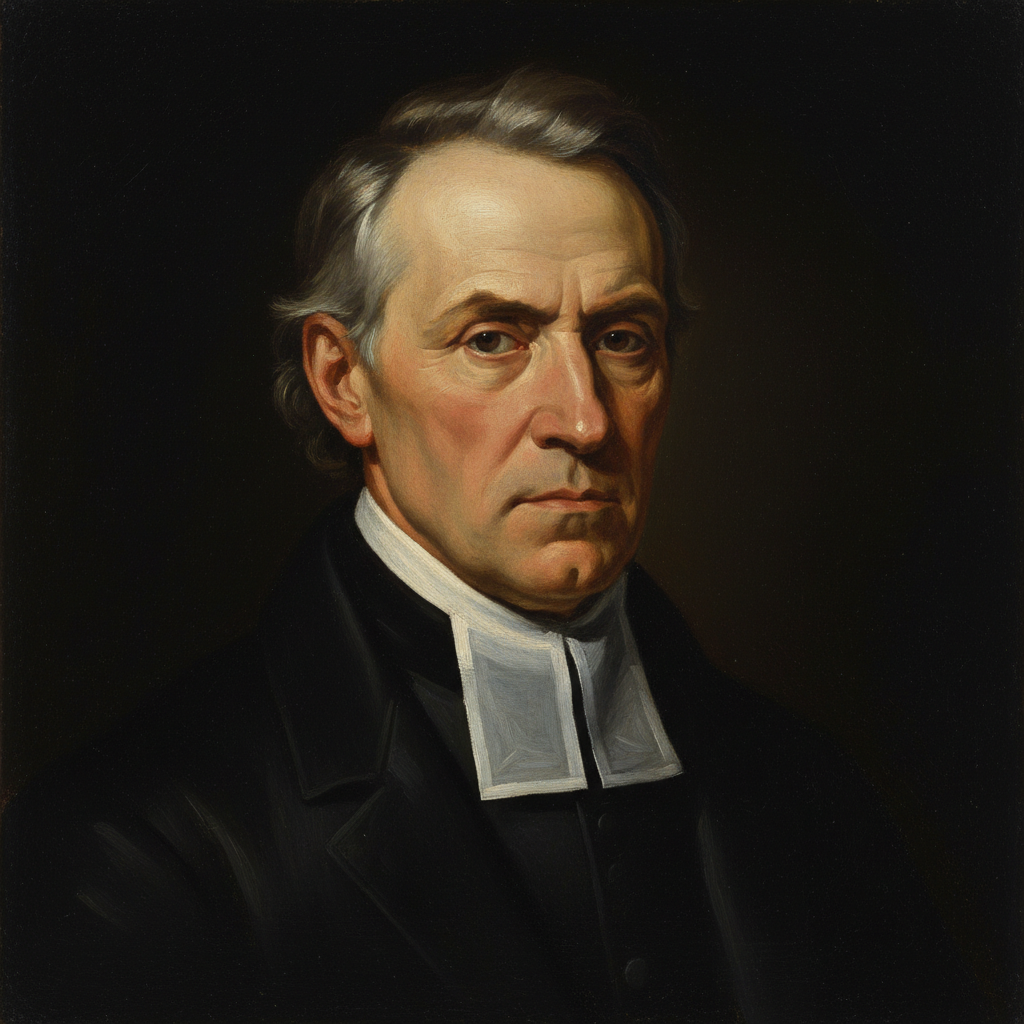
John Wesley — "God grant that we may all make a good end!"
God grant that we may all make a good end!
God grant that we may all make a good end!
Click any product to generate a realistic preview. Up to 3 at a time.
* Initial load can take up to 90 seconds — revising the preview in another color is nearly instant.
"The Methodists do not desire to be distinguished from other men, but by the Spirit which they breathe."
"I am not afraid that the people called Methodists should ever cease to exist either in Europe or America. But I am afraid lest they should only exist as a dead sect, having the form of religion withou…"
"I have often thought, that the best way to do good, is to do it as if you were doing it for yourself."
"To candid, reasonable men, I am not afraid to lay open what has been the course of my life."
"I am as much a High-Churchman as ever I was."
English Anglican cleric and founder of Methodism, whose open-air preaching and class-meeting structure created the largest 18th-century evangelical revival. Closely associated with Charles Wesley (his hymn-writing brother) and George Whitefield (early co-revivalist, later doctrinal opponent). For an intellectual contrast, see George Whitefield, Calvinist evangelical revivalist — Whitefield's predestinarian Calvinism vs Wesley's free-grace Arminian theology split the early Methodist movement permanently in the 1739-41 break. The founding evangelical Calvinist-Arminian schism — the two parallel evangelical traditions American Christianity descends from.
Found in 1 providers: grok
1 source checked
A communal prayer wishing that everyone, when their time comes, dies in a state of spiritual readiness — conscience clear, faith intact, and at peace with God. In modern terms: hoping no one faces death unprepared, in despair, or estranged from grace. It frames death not as something to dread but as a moral and spiritual culmination, and shifts focus from individual achievement to shared dependence on divine mercy.
Wesley dedicated his entire ministry to preparing souls for death through 'practical holiness' and constant self-examination. He traveled over 250,000 miles preaching salvation to the poor and dying, and founded Methodist class meetings partly as accountability structures for spiritual readiness. His movement obsessed over deathbed accounts as evidence of genuine faith. Wesley himself died peacefully in 1791, reportedly saying 'The best of all is, God is with us' — the very 'good end' he prayed others would receive.
In 18th-century Britain, death was constant and public — high infant mortality, epidemic disease, industrial accidents, and warfare made sudden death routine. The Church of England offered little pastoral comfort to the poor. Deism was quietly eroding traditional religious certainty among educated classes. Wesley's Methodist revival arose to restore personal assurance of salvation amid widespread spiritual anxiety. A 'good end' was a genuine social preoccupation, not a platitude, when most people died without medical care or institutional spiritual support.
AI-generated insights based on extensive research and information for context. Factual errors? Email [email protected].
Your cart is empty