What it means
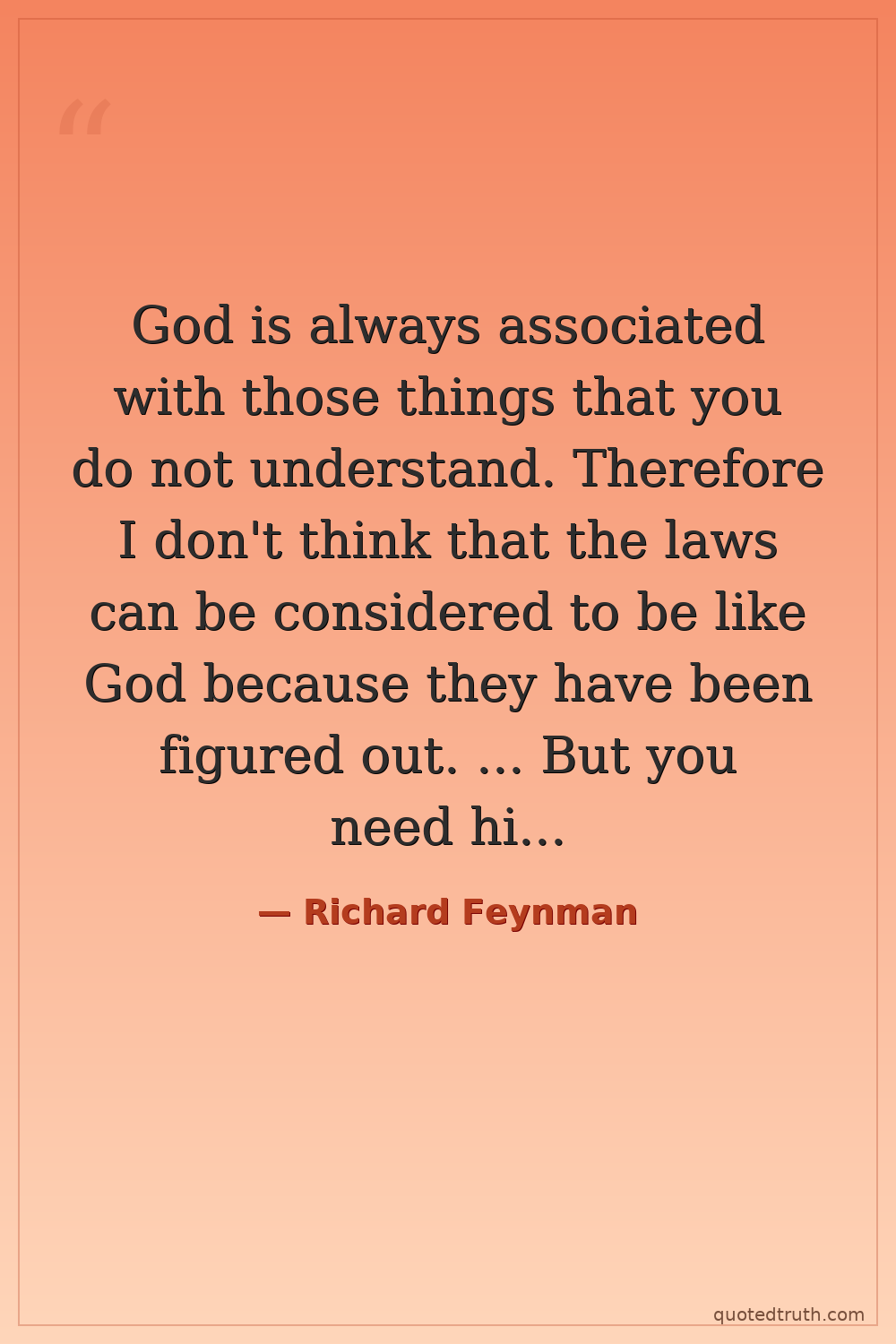
God gets assigned to whatever humans cannot yet explain. Once science cracks a mystery, God gets pushed back to the remaining unknowns. This creates a shrinking role for the divine — a placeholder for ignorance rather than a settled answer. Feynman is not dismissing God but observing how religious belief tends to occupy the frontier of human understanding, retreating as knowledge advances.
Relevance to Richard Feynman
Feynman spent his career dismantling mysteries through rigorous physics — developing quantum electrodynamics, winning the Nobel Prize, exposing the Challenger disaster cause. He was a proud agnostic who valued intellectual honesty over comforting beliefs. This quote captures his signature move: treating religious claims with the same unflinching curiosity he applied to nature, neither mocking faith nor accepting it uncritically.
The era
Feynman spoke during the mid-to-late 20th century, when science had achieved extraordinary explanatory power — splitting atoms, mapping DNA, landing on the moon. Yet consciousness, the origin of the universe, and death remained stubbornly unexplained. This tension between triumphant materialism and persistent existential mystery defined postwar intellectual culture, making his 'God of the gaps' observation both timely and pointed.
AI-generated insights based on extensive research and information for context. Factual errors? Email [email protected].