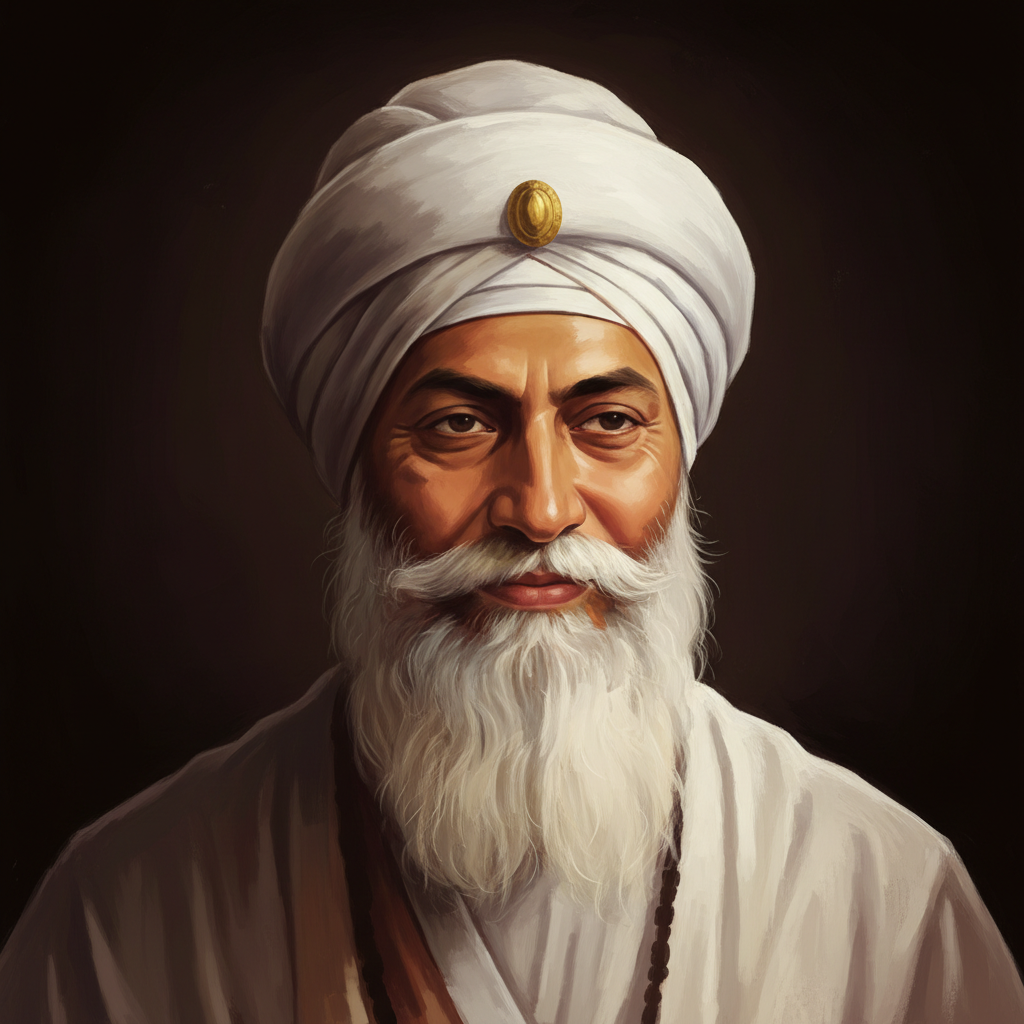
Guru Nanak — "God is neither established nor created. He is self-existent."
God is neither established nor created. He is self-existent.
God is neither established nor created. He is self-existent.
Click any product to generate a realistic preview. Up to 3 at a time.
* Initial load can take up to 90 seconds — revising the preview in another color is nearly instant.
"The lowest among the low castes, lower than the lowliest, Nanak is with them: He envies not those with worldly greatness."
"Emotional attachment to Maya is totally painful, this is a bad bargain."
"Hindus are getting Spiritually ruined by worshiping their idols all life and the Muslims by bowing their heads towards Mecca (believing that God exists only in Mecca); but both do not understand/reali…"
"Dwell in peace in the home of your own being, and the Messenger of Death will not be able to touch you."
"The highest religion is to rise to universal brotherhood; aye, to consider all creatures your equals."
Founder of Sikhism and the first of the Ten Sikh Gurus, whose teachings of one universal God and rejection of caste shaped Punjab. Closely associated with Kabir (mystical poet whose verses appear in the Sikh Guru Granth Sahib). For an intellectual contrast, see Brahmanical orthodoxy, the Hindu caste-and-ritual establishment of his era — Sikhism was founded as a deliberate alternative to both Hindu ritual hierarchy and Islamic exclusivism — Nanak's universalism was a structural rejection of caste and priestly mediation.
Found in 1 providers: gemini
1 source checked
This statement says the divine was never made, built, or brought into being by anyone or anything. God exists on God's own, independent of cause, creation myth, ritual, or human institution. There is no origin story, no birthday, no founding moment. The divine simply is, self-sustaining and uncaused, and therefore cannot be owned, housed, or manufactured by priests, temples, idols, or empires claiming to speak for it.
Guru Nanak founded Sikhism on the Mool Mantar, which opens with 'Ik Onkar'—one self-existent creator, 'Ajuni Saibhang' (unborn, self-illumined). Raised Hindu in a Muslim-ruled Punjab, he rejected both idol worship and ritualized monotheism after his river vision at Sultanpur. He traveled across India, Tibet, and Mecca teaching that God needs no image, incarnation, or intermediary, a conviction this line distills precisely.
Nanak lived 1469–1539 in Punjab, under the late Delhi Sultanate and early Mughal conquest by Babur, whose 1526 invasion he witnessed. Hindu bhakti saints and Sufi mystics were already challenging caste, ritual, and clerical gatekeeping. Temples charged fees, Brahmins guarded Sanskrit scripture, mullahs enforced orthodoxy. Declaring God uncreated and self-existent stripped both establishments of their claim to manufacture access to the divine, a radical leveling message for a religiously polarized society.
AI-generated insights based on extensive research and information for context. Factual errors? Email [email protected].
Your cart is empty