What it means
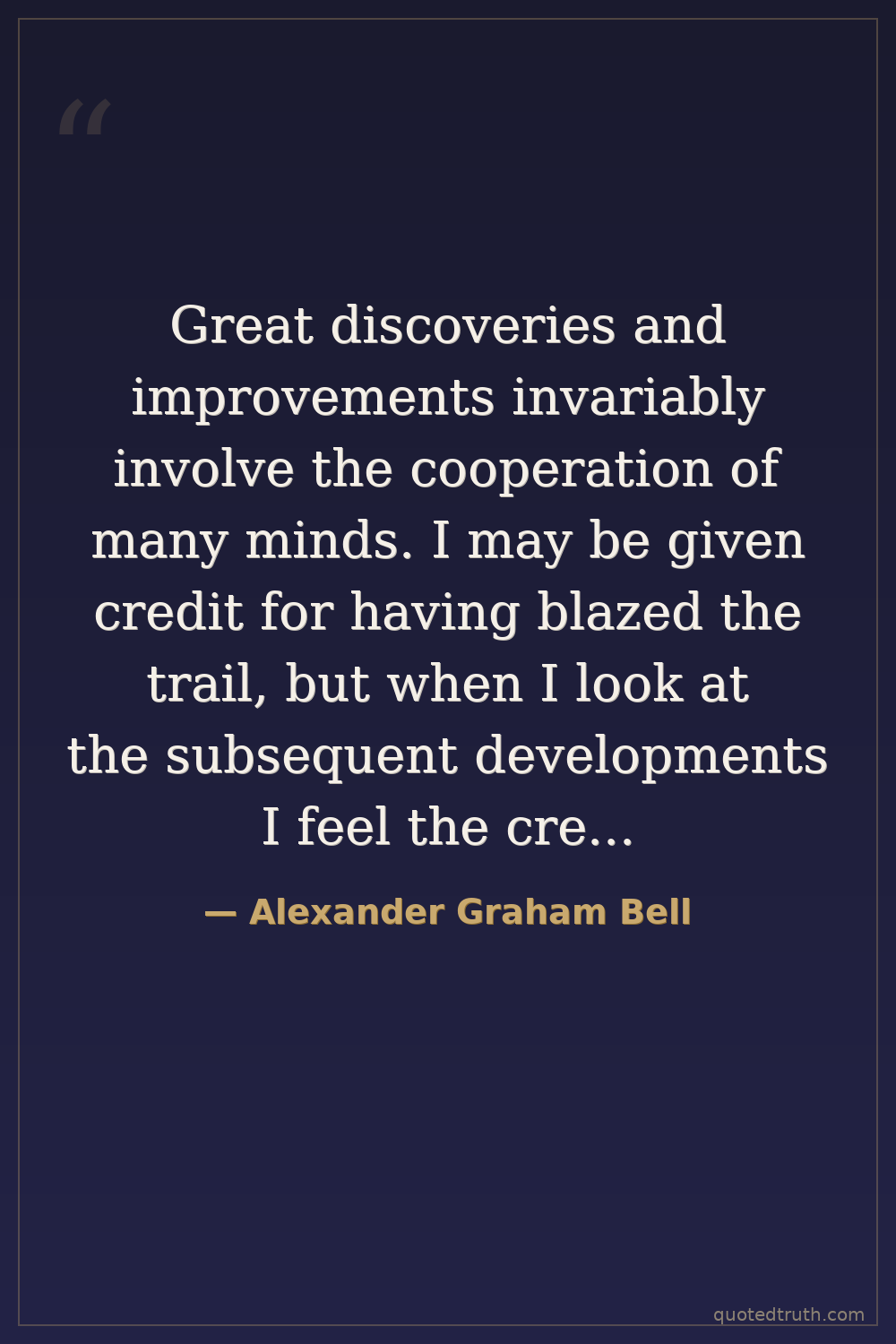
No great invention or breakthrough belongs to a single person. Progress is collaborative—one person may strike the first spark, but it takes the collective effort of countless others to turn an idea into something transformative. Even those who receive fame for starting something often recognize that the people who came after, refined, and built upon the original idea deserve more recognition than the person who first got there.
Relevance to Alexander Graham Bell
Bell knew the telephone wasn't solely his achievement. He worked hand-in-hand with Thomas Watson, whose mechanical skill translated Bell's concepts into working hardware. His 1876 patent was fiercely disputed—Elisha Gray filed a competing caveat the same day, and Antonio Meucci had demonstrated similar technology years earlier. After patenting the telephone, Bell largely moved on to other pursuits—the photophone, hydrofoils, aviation—leaving others to build the global communications network his invention made possible.
The era
Bell's era was the Gilded Age of invention, when the lone genius myth was aggressively cultivated—Edison being its most famous practitioner. Patent wars were vicious and commercially driven. The telephone's transformation into a global network required hundreds of engineers, investors, and operators Bell himself had no part in building. His era also saw bitter priority disputes over who truly invented the telephone. Against that backdrop of ego and litigation, publicly crediting collaborators was a genuinely radical act.
AI-generated insights based on extensive research and information for context. Factual errors? Email [email protected].