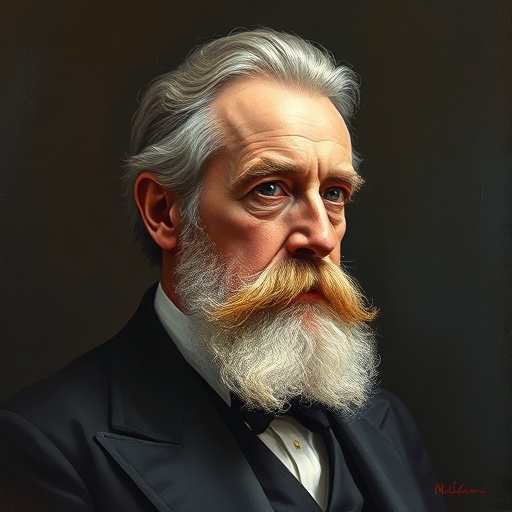
Alexander Graham Bell — "I am a firm believer in the future of aviation."
I am a firm believer in the future of aviation.
I am a firm believer in the future of aviation.
Click any product to generate a realistic preview. Up to 3 at a time.
* Initial load can take up to 90 seconds — revising the preview in another color is nearly instant.
"Leave the beaten track occasionally and dive into the woods. Every time you do so you will be certain to find something that you have never seen before."
"We should not permit the deaf to intermarry, nor should we permit the marriage of a deaf-mute with a hearing person, nor the marriage of persons with deaf relatives."
"I begin my work at about nine or ten o'clock in the evening and continue until four or five in the morning. Night is a more quiet time to work. It aids thought."
"We are all born with a certain potential, and it is up to us to fulfill it."
"Mr. Watson—Come here—I want to see you."
Reflecting his later interest and contributions to aeronautics.
Date: c. 1900-1910
Self-DeprecatingFound in 1 providers: grok
1 source checked
Bell is declaring confident faith that flight technology will develop into something genuinely transformative for humanity. He is not treating aviation as a stunt or a curiosity but as a field with serious, unrealized potential. The statement pushes back against skeptics who dismissed early aircraft as impractical, arguing instead that powered human flight would grow into something that fundamentally changes how civilization moves and connects across distances.
Bell was far more than a telephone inventor. He co-founded the Aerial Experiment Association in 1907, helping produce the Silver Dart, the first powered aircraft to fly in Canada. He spent years designing tetrahedral kites and experimental aircraft frames alongside Glenn Curtiss. His belief in aviation was not rhetorical—it was backed by active research. Expanding the boundaries of human communication and movement was the through-line of his entire career.
The Wright Brothers flew at Kitty Hawk in 1903, but public and institutional skepticism about aviation's practical future remained intense through the early 1900s. Governments were slow to fund it, and many engineers dismissed it as novelty. Bell's endorsement carried unusual weight: his telephone had already proven that a technology could go from laboratory curiosity to world-altering infrastructure within decades, making his faith in aviation a meaningful signal to investors and policymakers.
AI-generated insights based on extensive research and information for context. Factual errors? Email [email protected].
Your cart is empty