What it means
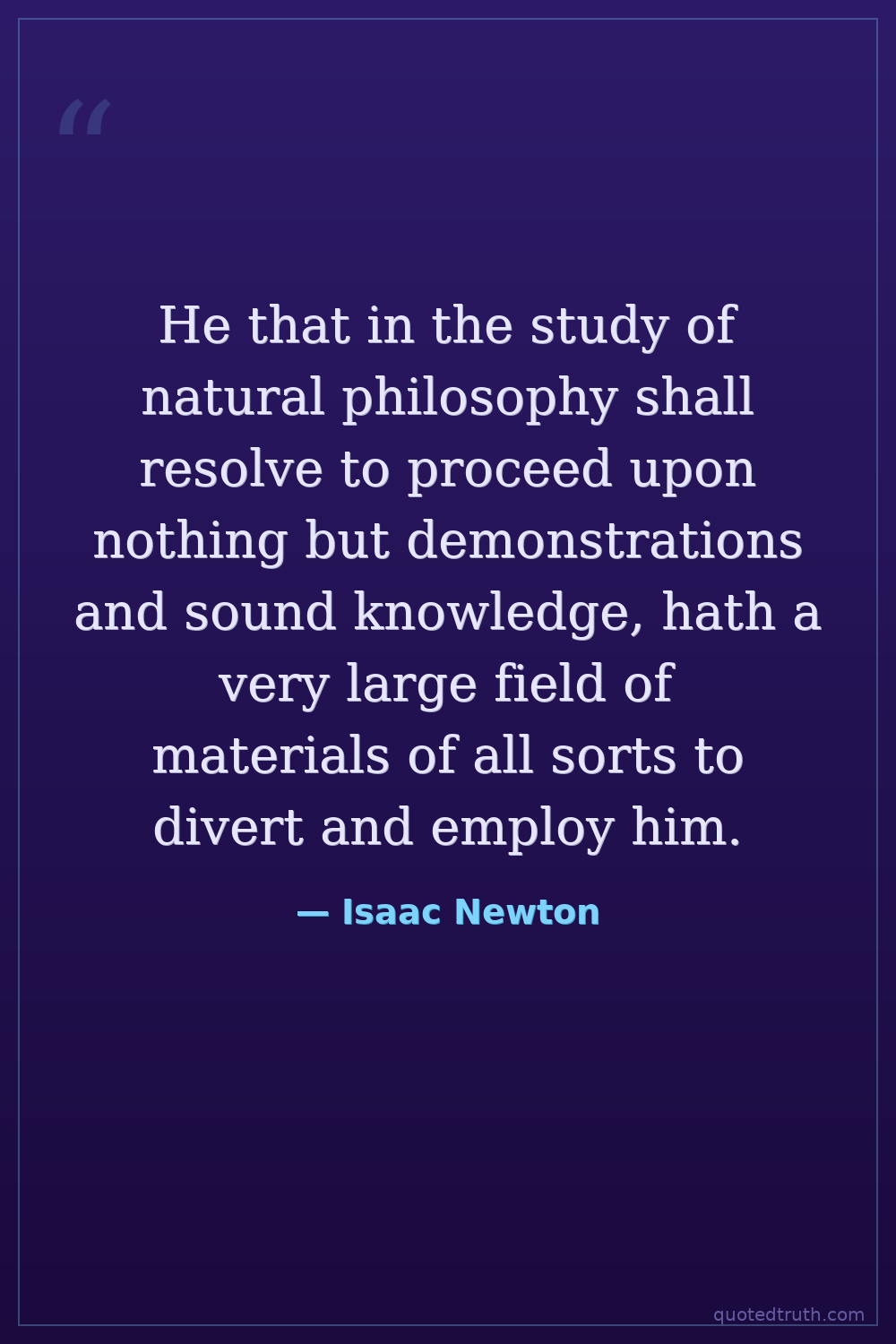
Anyone who commits to studying nature using only provable demonstrations and verified knowledge—not speculation or inherited authority—will find an inexhaustibly rich field of inquiry awaiting them. Far from being limiting, rigorous standards of proof open up vast territory. The constraint of requiring evidence doesn't shrink science; it reveals how much genuine, demonstrable truth remains uncovered. Empirical discipline is not a cage but an invitation to limitless legitimate discovery.
Relevance to Isaac Newton
Newton famously declared 'hypotheses non fingo'—I feign no hypotheses—refusing to speculate beyond what mathematics and experiment could prove. He spent decades perfecting Principia Mathematica before publishing, and conducted thousands of meticulous optics experiments. His laws of motion and gravity arose from rigorous demonstration, not intuition alone. This quote is his working philosophy made explicit: empirical method was not a constraint but the engine that drove the greatest scientific breakthroughs of his century.
The era
In Newton's era, natural philosophy still battled scholasticism—universities taught Aristotelian qualities and occult causes rather than measurable forces. Descartes' competing system relied on rationalist speculation over experiment. The Royal Society, founded 1660, championed empirical demonstration with its motto Nullius in verba—take nobody's word for it. Newton wrote amid this collision between tradition and experiment, when insisting on demonstration alone was itself a radical act, positioning rigorous science against centuries of inherited authority.
AI-generated insights based on extensive research and information for context. Factual errors? Email [email protected].